A Quantum-Inspired Multimodal Optical–Electrical Sensor Platform for Tissue and Biofluid Characterization
Victor Pronchev¹, et al.
¹Independent Research Group for Quantum-Inspired Biosensing Systems
Abstract
Recent advances in quantum sensing, optical spectroscopy, and bioimpedance analysis have opened new opportunities for high-resolution characterization of biological tissues and biofluids. This work presents a quantum-inspired multimodal sensing platform combining near-infrared (NIR) spectroscopy, coherent optical interaction using ytterbium-doped crystal media, electrical impedance spectroscopy (EIS), and controlled electromagnetic modulation. The system integrates InGaAs photodiodes, NIR spectrometry, microwave-based modulation sources, and synchronized data acquisition to produce a multimodal feature space describing tissue-like phantoms and ex-vivo biological samples.
The architecture enables simultaneous acquisition of optical spectral signatures, electrical impedance spectra, and electromagnetic response characteristics under controlled experimental conditions. The resulting dataset forms a multidimensional signature space suitable for statistical analysis and machine-learning-assisted classification of tissue properties.
The proposed platform does not aim at clinical treatment but rather at high-resolution sensing and characterization, enabling exploration of quantum-inspired measurement paradigms in biomedical research.
1 Introduction
The ability to distinguish biological tissue states using non-destructive sensing methods is an active research area in biomedical engineering. Recent developments in quantum sensing technologies, near-infrared spectroscopy, and bioimpedance spectroscopy have demonstrated potential for improved characterization of biological materials.
Optical spectroscopy has long been used to analyze biological tissue due to its sensitivity to molecular composition and scattering properties. Meanwhile, electrical impedance spectroscopy (EIS) provides complementary information related to ionic conductivity, membrane polarization, and dielectric relaxation.
In parallel, emerging research in quantum-inspired sensing architectures explores the use of coherent optical systems, advanced photodetection technologies, and multimodal data fusion for enhanced sensitivity.
In this work we present a multimodal sensing architecture combining optical, electrical, and electromagnetic modalities into a synchronized experimental platform designed for high-resolution characterization of tissue models and biological samples.
The proposed system integrates:
- coherent NIR optical excitation
- ytterbium-doped crystal stabilization modules
- InGaAs photodiode detection
- NIR spectrometry
- electrical impedance spectroscopy
- controlled electromagnetic modulation
- synchronized data acquisition and analysis
The goal is to construct a multidimensional measurement space capable of capturing subtle physical signatures of biological materials.
2 System Architecture
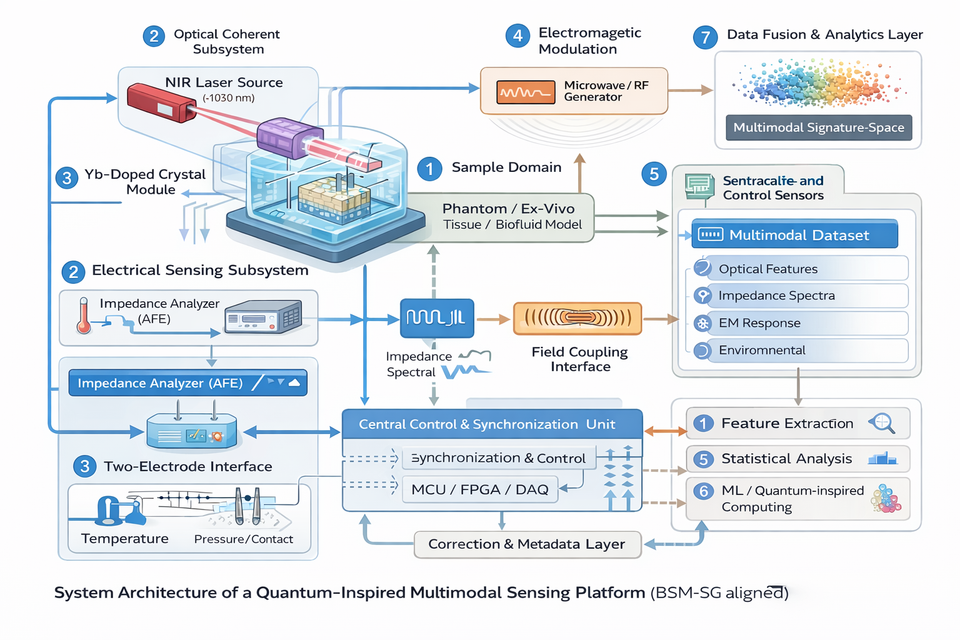
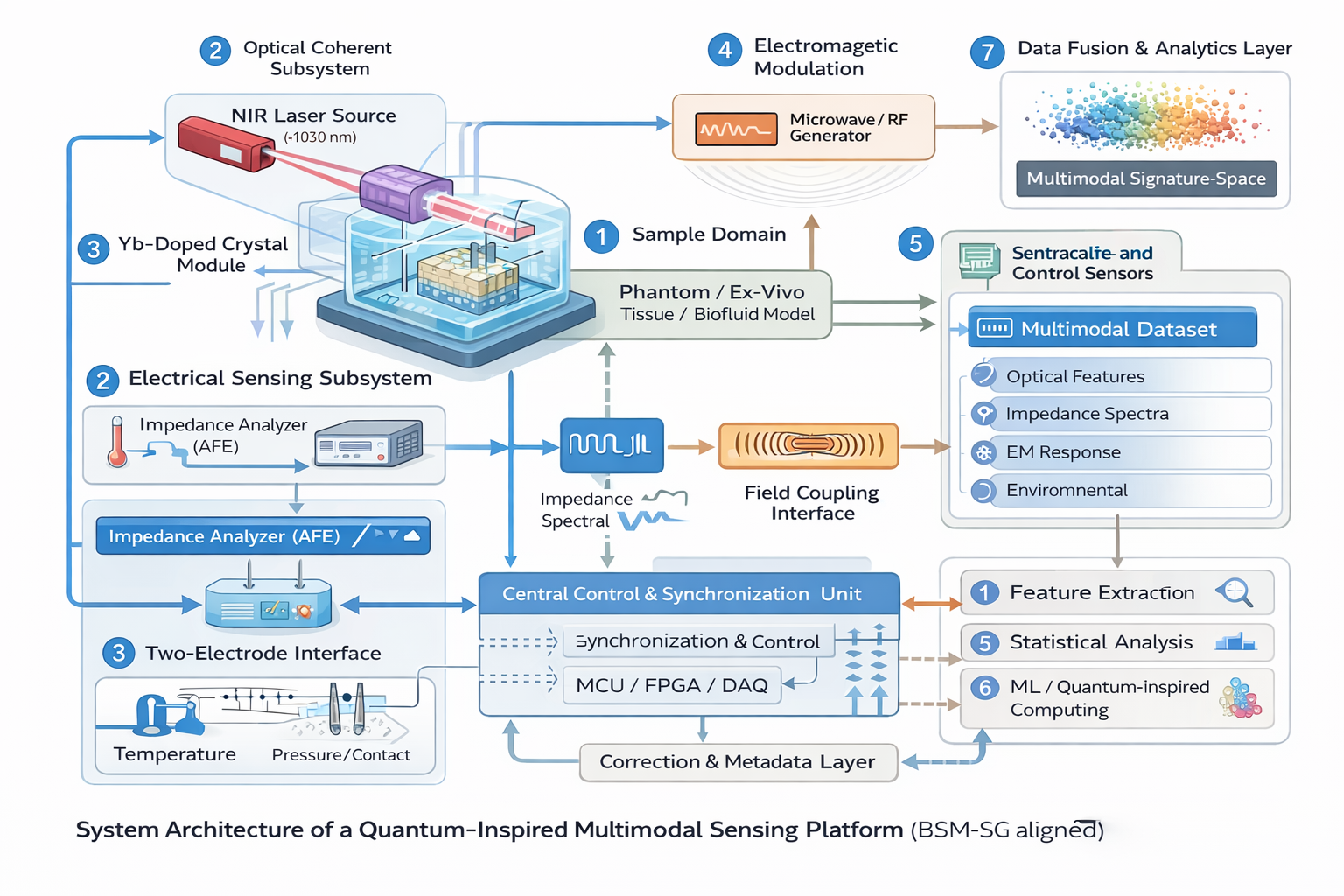
The sensing platform consists of five main subsystems:
- Optical coherent subsystem
- Electrical impedance subsystem
- Electromagnetic modulation subsystem
- Environmental monitoring subsystem
- Data fusion and analysis layer
The architecture enables simultaneous measurement of optical and electrical responses of a sample under controlled electromagnetic perturbations.
3 Optical Coherent Subsystem
3.1 NIR Laser Source
The optical subsystem is driven by a near-infrared laser source operating near 1030 nm, a spectral region widely used in biomedical spectroscopy due to favorable tissue penetration and reduced scattering effects.
The laser operates in either:
- continuous wave mode
- intensity-modulated mode
depending on the experimental protocol.
3.2 Ytterbium-Doped Crystal Module
A ytterbium-doped crystal medium (Yb:YAG class) is incorporated as an optical interaction module. Such media are widely used in high-coherence laser systems and provide a stable optical environment for coherent photon interactions.
Within the sensing architecture, the crystal acts as a coherent optical mediator, improving phase stability and spectral consistency of the illumination pathway.
3.3 Sample Optical Interaction
The optical beam interacts with the sample (phantom or ex-vivo tissue), producing:
- absorption features
- scattering effects
- spectral modulation
These interactions are captured by the detection subsystem.
3.4 Optical Detection
The detection module consists of two complementary elements.
InGaAs Photodiodes
InGaAs photodiodes provide high sensitivity in the near-infrared region and are used for:
- intensity measurements
- modulation detection
- lock-in amplification measurements
These detectors allow high temporal resolution measurements of optical signals.
NIR Spectrometer
A NIR spectrometer captures the spectral distribution of the optical signal, producing a wavelength-resolved signature of the sample.
The combination of these detectors enables simultaneous measurement of:
- spectral features
- temporal modulation characteristics
4 Electrical Impedance Spectroscopy Subsystem
Electrical impedance spectroscopy (EIS) is used to measure the frequency-dependent electrical properties of the sample.
An impedance analyzer (AD5933-class architecture) generates an AC excitation signal and measures the resulting voltage response across the sample.
The complex impedance is calculated as
Z(f)=R(f)+jX(f)Z(f) = R(f) + jX(f)Z(f)=R(f)+jX(f)
where
- RRR is the resistive component
- XXX is the reactive component.
The frequency sweep typically spans 1 kHz – 100 kHz, capturing ionic conduction and dielectric polarization behavior.
Two electrodes are used in a fixed geometry to ensure repeatability.
5 Electromagnetic Modulation Subsystem
A microwave/RF generator provides a controlled electromagnetic perturbation applied to the system.
The generator serves primarily as:
- a synchronization clock
- a modulation signal
- a perturbation source for system response analysis
This modulation allows investigation of dynamic response characteristics of the sensing platform.
6 Environmental Monitoring
Environmental sensors monitor experimental conditions to ensure measurement stability.
These include:
Temperature sensors
Pressure/contact sensors
Environmental noise monitoring
Such metadata are essential to separate true sample responses from environmental artifacts.
7 Data Acquisition and Synchronization
All measurement subsystems are controlled by a central acquisition unit consisting of:
- microcontroller or FPGA
- synchronized clock system
- data acquisition interfaces
The system records:
- optical intensity
- spectral data
- impedance spectra
- electromagnetic modulation parameters
- environmental measurements
All data streams are timestamped for synchronization.
8 Data Fusion and Feature Extraction
The collected data form a multimodal dataset.
Feature extraction techniques are applied to derive descriptors such as:
Optical features
Spectral peaks
Impedance magnitude curves
Phase dispersion
Electromagnetic response patterns
The resulting features are combined into a multimodal signature space.
Statistical analysis and machine learning techniques can then be applied to explore correlations between measurement features and sample properties.
9 Experimental Protocol
Experiments are performed on tissue-like phantoms and biological models under controlled laboratory conditions.
Typical experimental procedure:
1 Sample placement in measurement chamber
2 Optical excitation
3 Impedance frequency sweep
4 Electromagnetic modulation
5 Synchronized data acquisition
6 Feature extraction
Multiple repeated measurements ensure statistical reliability.
10 Potential Research Applications
The sensing architecture enables research in areas such as:
- tissue characterization
- biofluid analysis
- optical-electrical multimodal sensing
- quantum-inspired measurement techniques
- machine learning-based classification of biological samples
The system is intended strictly for research and sensing applications.
11 Discussion
The proposed architecture demonstrates how combining optical coherence systems, NIR spectroscopy, and impedance spectroscopy can generate rich multidimensional datasets describing biological materials.
Multimodal sensing may provide advantages over single-modality measurements by capturing complementary physical signatures.
Future research will focus on improving system sensitivity, expanding spectral ranges, and developing advanced data analysis algorithms.
12 Conclusion
This work introduces a quantum-inspired multimodal biosensing platform integrating coherent optical sensing, near-infrared spectroscopy, electrical impedance spectroscopy, and electromagnetic modulation.
The architecture provides a flexible experimental framework for the study of biological tissue models and biofluids.
By combining optical and electrical sensing modalities, the system generates a multidimensional measurement space suitable for advanced analysis and classification of biological materials.
Keywords
Quantum-Inspired Sensing
Near-Infrared Spectroscopy
Electrical Impedance Spectroscopy
Multimodal Biosensing
Biomedical Sensors
Optical Coherence
Tissue Characterization