From Vision to Validation: How Early Ytterbium Quantum Architectures Anticipated Optical Nuclear Spin Breakthroughs
Introduction
In recent years, quantum technologies have been steadily transitioning from abstract theoretical constructs into physically realizable systems, where control over quantum states is becoming increasingly precise and applicable.
Two years ago, within the framework of BSM-SG (Beyond Standard Model – Structured Geometry), we introduced a quantum processor architecture based on rare-earth elements, specifically ytterbium-doped crystals (Yb:YAG). The core idea was to leverage hybrid control mechanisms—combining optical, microwave, and electrical interactions—to manipulate and read quantum states.
This architecture was not only designed as an engineering solution but also as part of a broader theoretical framework, where quantum states are treated as resonant structured field configurations, rather than isolated particles.
BSM-SG: The Theoretical Foundation
Within the BSM-SG framework, quantum states can be interpreted as:
- stable resonant structures
- localized within specific field geometries
- exhibiting varying degrees of interaction with their environment
From this perspective:
- electronic states correspond to higher-energy, faster, and more interactive modes
- nuclear spin states correspond to deeply localized, weakly interacting, and highly stable configurations
This naturally leads to the concept of a hybrid quantum architecture, where:
- fast modes are used for processing
- stable modes are used for memory
Our Ytterbium-Based Architecture
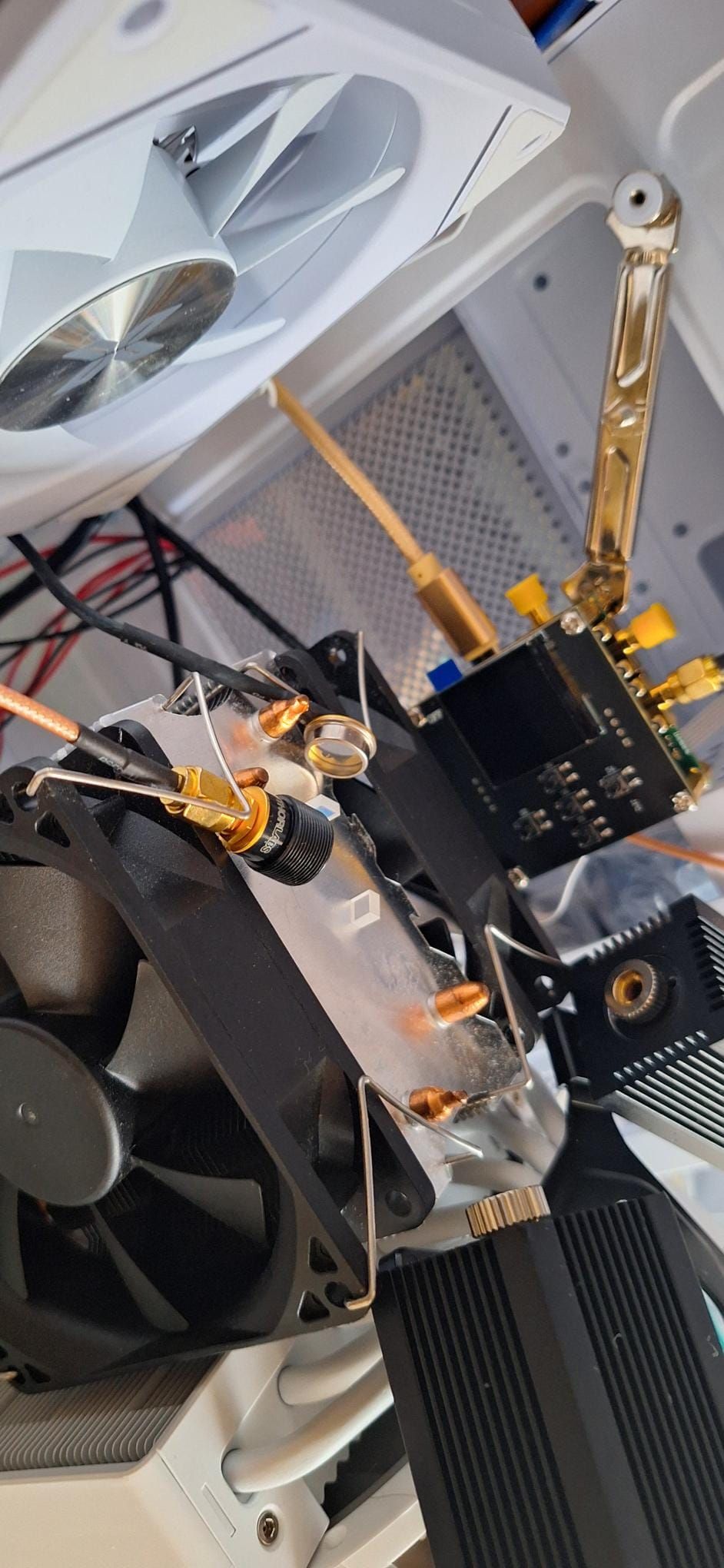
Our developed system includes:
- Yb:YAG crystal as the quantum medium
- laser excitation (~1030 nm)
- microwave control for state manipulation
- optical readout via photodiodes
- multimodal control (optical + electrical + high-frequency fields)
The goal of this architecture is to achieve:
- hybrid quantum states (electronic + nuclear)
- high processing speed combined with long coherence times
- scalability toward practical systems
🧩 Architecture Overview


4
Conceptual Layers:
- Quantum Medium Layer – Yb:YAG crystal hosting quantum states
- Control Layer – laser + microwave excitation
- Coupling Layer – interaction between electronic and nuclear states
- Readout Layer – optical detection (photodiodes)
- Field Control Layer – electrical + high-frequency modulation
Recent Experimental Breakthrough
A recent experimental result reported by Karlsruhe Institute of Technology and covered by Phys.org demonstrates:
- optical initialization of nuclear spin states
- control via high-frequency fields
- coherence times on the millisecond scale
🔗 Read the article:
https://phys.org/news/2026-04-optical-nuclear-molecules-paths-quantum.html
Convergence of Ideas
What makes this result particularly significant is not only the experiment itself, but the fact that it independently validates key principles previously outlined in our work:
- Optical interfacing with stable internal quantum states
- Separation between fast and stable quantum modes
- Hybrid control as a fundamental architectural requirement
This represents a natural convergence of research directions, where different implementations begin to align around shared physical principles.
From Molecular Systems to Solid-State Platforms
While the recent experiment relies on molecular systems involving europium, our approach is based on a solid-state platform.
This distinction enables:
- easier integration into practical devices
- a more stable and controllable environment
- compatibility with photonic and electronic systems
Perspective
The evolution of quantum technologies suggests that:
- there is no single path toward a functional quantum computer
- but there are emerging underlying principles that appear consistently across different systems
Our work on ytterbium-based architectures and the BSM-SG framework fits within this emerging landscape, representing an early step toward hybrid quantum systems that unify stability and control.
Conclusion
Recent experimental advances demonstrate that quantum systems based on optical control and stable internal degrees of freedom are not only feasible but highly promising.
These developments reinforce the direction we have been pursuing and open the door to future exploration, where different approaches may converge, interact, and evolve into more powerful hybrid quantum architectures.