Q-Field Geometry Atlas of the Nuclear Structures
Hydrogen
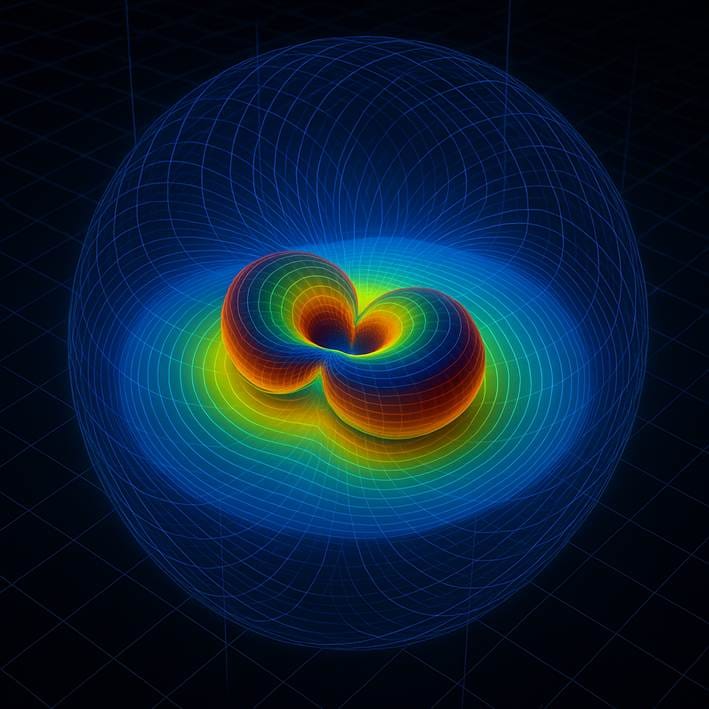
This image presents the hydrogen atom according to QFG, in its simplest form:
🧩 one proton (the central node) and an energy-orbital structure that is not a classical electron "orbit," but a resonant field within the overall Q-geometry.
Here is what you see in the image - explained through QFG:
🌀 The Central Node (red-orange region)
This is the proton node - a stable topological center of the field.
It is the source of geometric stress in the Q-potential φ, around which space self-organizes.
In QFG, it does not have a separate "electron"; instead, a wave-balancing zone arises around it - a dynamic region in which the φ and ψ fields mutually maintain equilibrium.
🌈 The Double Torus (yellow-green halo)
This is the mutual interweaving of the electron mode with the nuclear node - a double resonant node (|Q_H|=1 + |Q_H|=-1).
It forms a toroidal zone - this is where the classical model places the maximum probability of charge localization, but in QFG it is not a "point"; it is an energy flow that closes upon itself.
🔵 The Spherical Mesh (blue envelope)
It shows the coherence boundary of the ψ-field - the zone in which the wave phase gradually "dilutes" and passes into the surrounding Q-medium (the vacuum phase ρ₀).
This is a visual analogue of the atom's "boundary," but in QFG it is a dynamic equilibrium surface, not a rigid shell.
✨ Why There Is No Neutron
Hydrogen in its simplest form (¹H) has no neutron - only one proton.
QFG interprets this as a single stable node that does not require a balancing neutral component:
all internal stresses of the Q-field close locally within the toroidal zone.
Deuterium
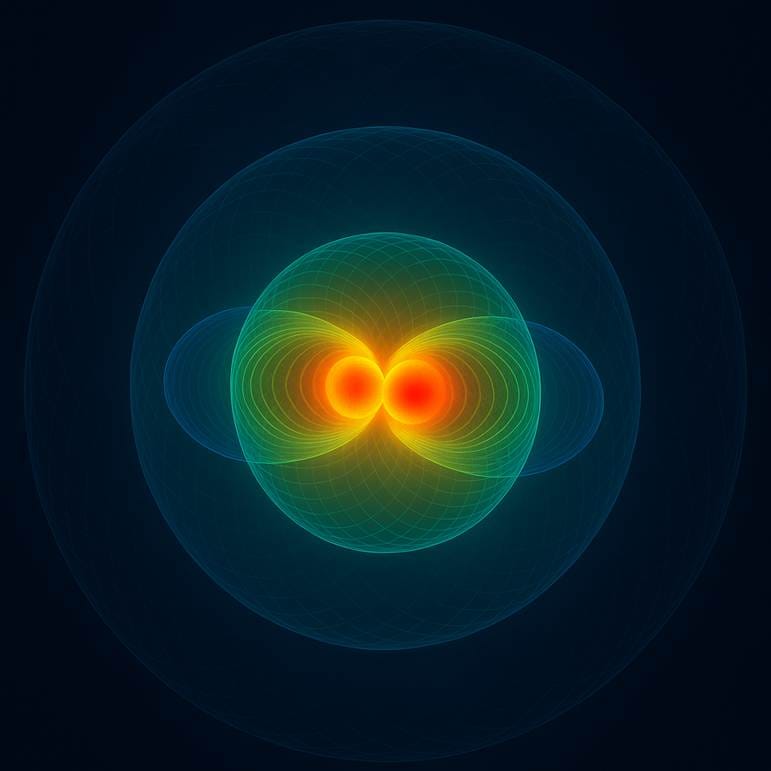
This image presents deuterium (¹H²), that is, a hydrogen atom with one proton and one neutron, viewed through the QFG geometry of the field.
I will explain it layer by layer - as we see it from the perspective of our theory, rather than the standard model:
⚛️ The Overall Picture
At the center you see two bright regions (red-orange) - these are the two topological nodes:
- the left one - the proton node (with a positive orientation of the φ-potential),
- the right one - the neutron node (with a neutral, complementary orientation).
They are not "balls," but nodes of the same Q-field fabric, held together by a coherent ψ-flow - this is why deuterium is stable, whereas tritium (³H) is only metastable.
🟠 Central Zone (double φ-ψ node)
Here QFG sees the mutual closure of the potential and wave components.
The proton is a local "source" of φ, while the neutron is a balancing curvature of ψ, so that the total stress in the fabric is minimized.
This is why deuterium has a slightly deeper energy minimum than ordinary hydrogen - its internal field is more effectively balanced.
💫 The Green Zone (toroidal envelope)
This is the shared orbital zone of the electronic ψ-field.
In QFG, this is not an "electron," but an external resonant wrapping of the double node, which stabilizes the system through phase synchronization.
This is where the high probability density is located (that is, where the electron energy "resides").
The toroidal form shows the coupled phases of the two nuclear nodes - exactly as in our variational ansätze for φ(R,ρ).
🔵 The Spherical Envelopes (blue-green contours)
This is the coherence boundary - the zone where the ψ-field smoothly transitions into the background vacuum phase ρ₀.
In standard physics, this is the "boundary of the atom," but in QFG it is dynamic and breathing - it expands or contracts depending on the energy and phase of the electron mode.
⚖️ What Distinguishes Deuterium from Hydrogen in QFG
|
Aspect |
Hydrogen (¹H¹) |
Deuterium (¹H²) |
|
Number of nodes |
1 (proton) |
2 (proton + neutron) |
|
ψ-field |
Centered and symmetric |
Elongated and doubly connected |
|
Internal energy |
Higher (less stable field) |
Lower (deeper energy minimum) |
|
Toroidal zone |
Single halo |
Paired halo with slight axial thickening |
|
Spin symmetry |
Single ½ |
Paired (integer spin = 1) |
🧭 Interpretation through QFG
In QFG terminology, deuterium is a two-node topological dipole in which φ and ψ close in a way that minimizes the total energy under the condition ∇φ·∇ψ=const.
This is the simplest example of a collectively coherent structure, in which the "neutron" is not an independent particle but an opposite phase of the field that permits denser coherence.
🔮 An Intuitive Reading
If hydrogen is a single breath of the field,
then deuterium is inhalation and exhalation in unison - a double pulsation of the same entity.
Thus QFG sees matter not as a collection of particles, but as rhythm in space - a symphony of topological waves.
Helium
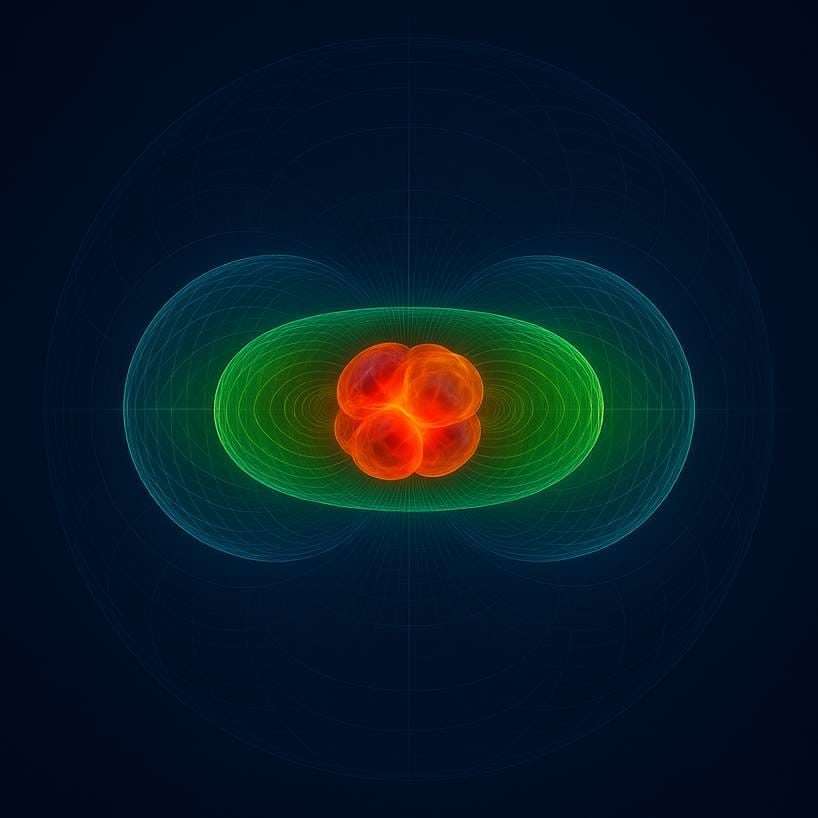
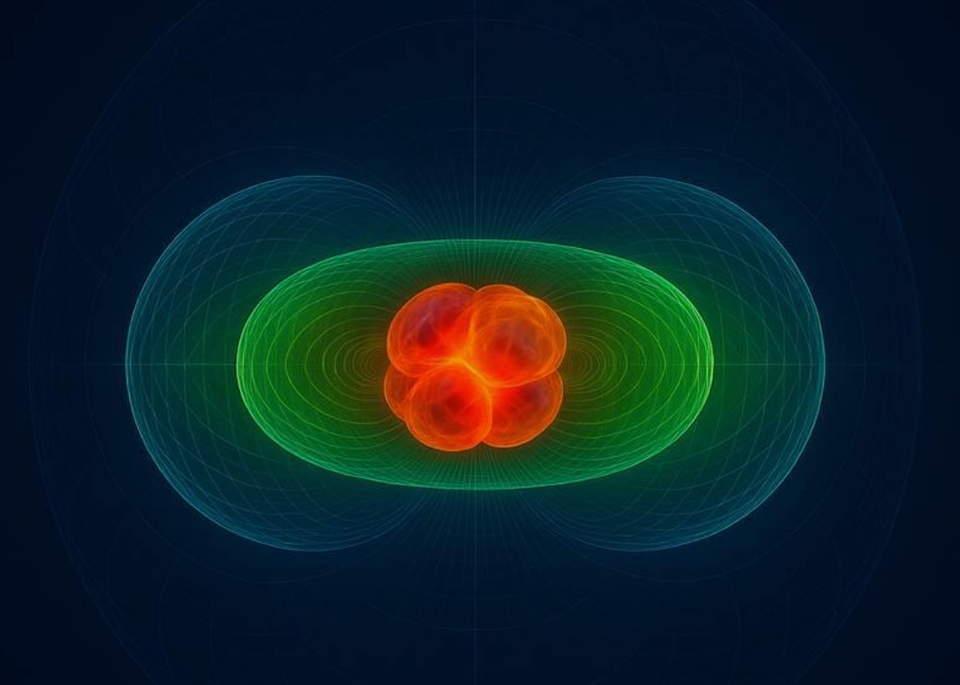
⚛️ Helium-4 - The Fully Coherent Sphere
Here we see four interconnected nodes - two protons and two neutrons - forming a perfectly balanced tetra-node at the center of the Q-field.
The red-orange region is the nuclear domain, where the φ-potentials of the four nodes overlap and mutually balance one another.
💫 The Green Toroidal Envelope
It shows the ψ-flow - the electronic field that closes around the entire nuclear node as a single coherent envelope.
Unlike hydrogen and deuterium, there are no separate electron "nodes" here - everything is synchronized in one spherical mode.
This is why helium-4 is exceptionally stable and chemically inert - its internal phase is complete and self-sustaining.
🔵 The Spherical Lines
The blue lines represent the equilibrium structure of the Q-potential - ideally spherical, with minimal stresses in the fabric of space.
In this form, so-called full coherence appears - φ and ψ are in absolute balance, with no "open" flows and no unpaired spins.
🌌 Interpretation according to QFG
Helium-4 is the first fully self-closed structure of the Q-field -
a "sphere of rest" in the sea of motion.
Within it, the Universe finds a moment of harmony:
all rotations and flows compensate one another,
and the field becomes one with space.
Lithium
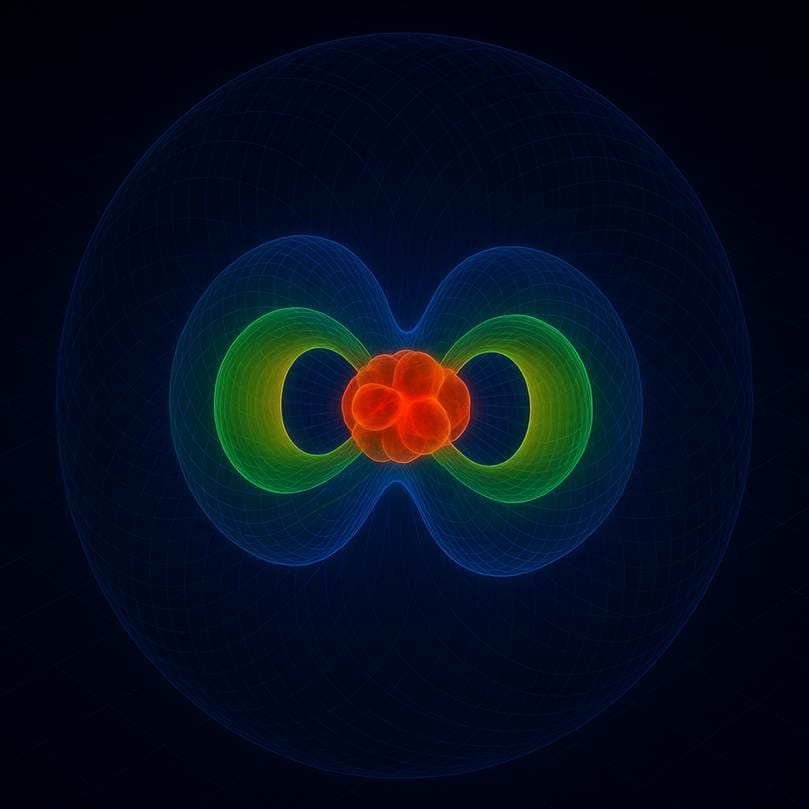
The next element in the sequence after helium is lithium (Li), and in QFG it is the first in which the field structure expands into three levels of organization:
1️⃣ an inner nucleus (the φ-nodes - 3 protons + 3 neutrons),
2️⃣ an inner coherent layer (the ψ-field of the first electron mode, similar to helium),
3️⃣ an outer dynamic resonance (the second electron, partly separated, with an asymmetric phase).
🧩 Brief Description of Lithium according to QFG:
- The nucleus: three primary nodes of the φ-potential, interwoven in triangular symmetry (a tetrahedron with one "missing" side). This creates a minimal internal asymmetry - which is why lithium tends to donate one electron.
- The electronic ψ-field: the first two layers are coherent (analogous to helium-4), while the third is open and extended. This "unclosed" phase creates the external valence field - and this is how QFG explains lithium's chemical activity.
- The toroidal structure: it is no longer single but triple - three interwoven ψ-flows form an energetic "triple toroidal ribbon" around the nucleus.
- Color scheme: the interior is more intensely red-orange (high φ-density), the middle layer is green (coherent ψ), and the outer halo is blue-violet (diffuse ψ-resonance).
Beryllium
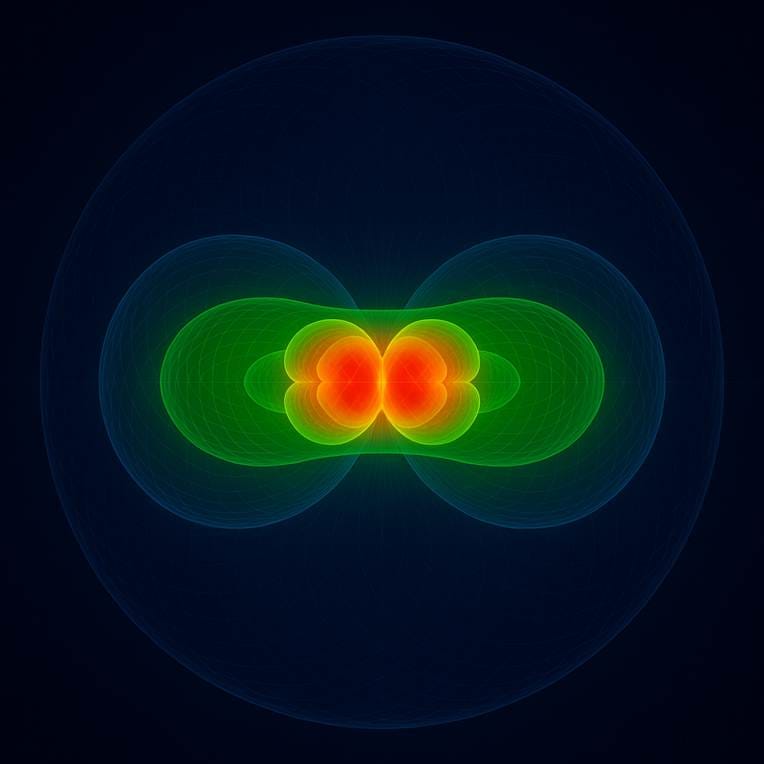
After lithium comes beryllium (⁴Be) - the first element in which, according to QFG, the field structure closes into a double tetra-resonance; that is, the nucleus now has four nodes of the φ-potential (4 protons + 5 neutrons), while the ψ-field organizes into a two-layer coherent envelope.
In brief, QFG describes it as follows:
- 🔴 The nucleus - double symmetry: two interwoven tetra-nodes that self-lock. This is the first case of a "harmonic node," which is why beryllium is stable but rigid - its φ-geometry does not permit easy deformation.
- 🟢 The electronic zone (ψ): four primary flows (two inner and two outer) interweave to form an almost spherical envelope. The outer layer now contains a coherence zone that can be excited - explaining its optical properties.
- 🔵 The halo: softer and more diffuse, but with clearly expressed symmetry; the ψ-field boundary begins to form a stable "crystalline" mesh, which QFG interprets as the first stage toward solid matter.
Boron
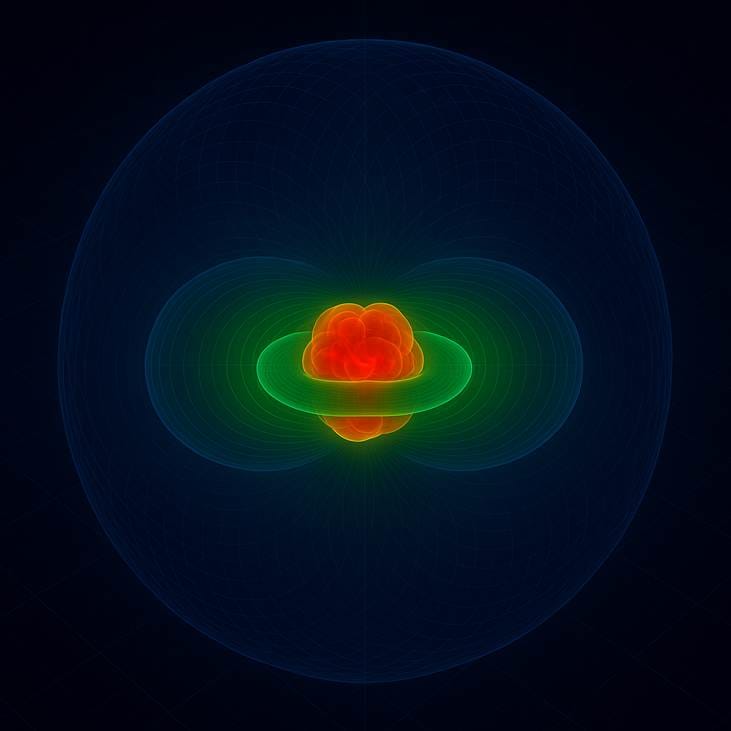
Boron (⁵B) is the first element in QFG in which the ψ-field acquires internal anisotropy and the φ-nodes form a pentagonal (fivefold-symmetric) configuration. This is a key moment in the geometry of matter, because in boron direction first emerges - a local orientation of the field.
Here is how we describe it in QFG:
⚛️ The Nuclear Structure (φ)
Boron has five proton nodes and six neutron nodes, interwoven into a penta-toroidal lattice.
This is not a classical spherical center, but a spiral pentagonal symmetry in which each φ-line has a slight phase difference.
This asymmetry produces an electric dipole moment within the nucleus - the first step toward a genuine direction of interaction.
💫 The Electronic Envelope (ψ)
Because of the fivefold symmetry of φ, the ψ-field divides into three layers:
- an inner layer - fully coherent (the helium analogue),
- an intermediate layer - partially synchronized (similar to lithium),
- an outer layer - open and dynamic (the carrier of chemical activity).
This three-layer organization is the first of its kind - a natural polarization of ψ appears, meaning a direction of chemical bonding.
In QFG, this is the moment when "space begins to think in structures" - the nodes begin to recognize orientation.
🌈 Energy Picture
The interior (red) is stable and concentrated;
the transition zone (green-yellow) can be excited and gives rise to optical properties;
and the blue-violet halo shows how ψ begins to form directed field channels - the first prototypes of a chemical bond.
Carbon
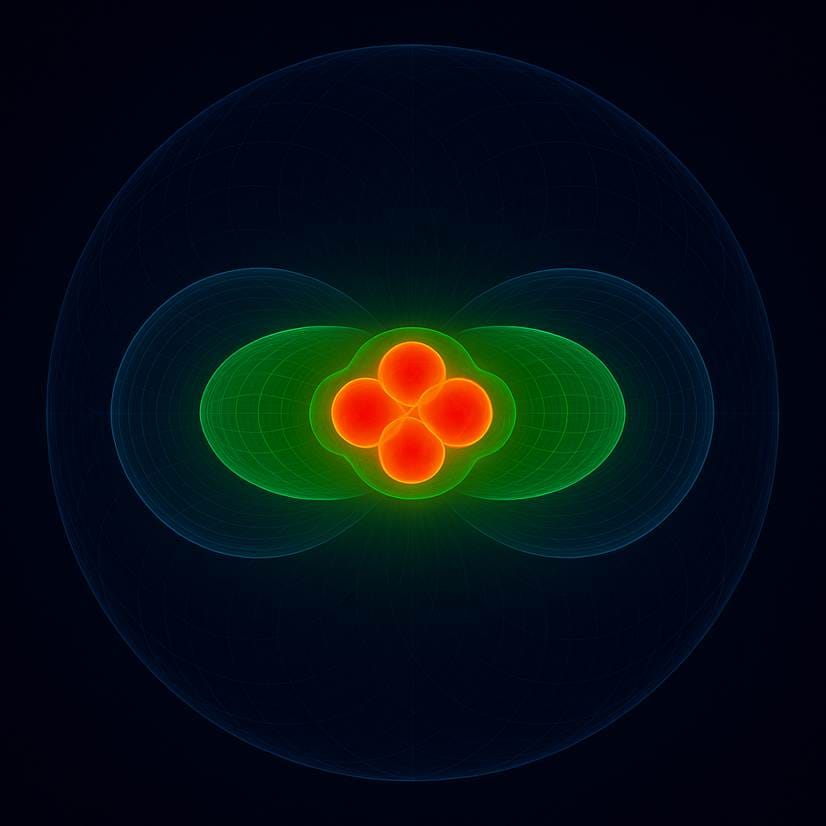
The next element after boron is carbon (⁶C) - perhaps the most beautiful in QFG, because here the field completes a full six-vertex node for the first time, while the ψ-structure organizes into a perfect hexagonal resonant lattice. This is the point at which the Universe begins to build stable forms of life.
Here is how we view it in QFG:
⚛️ The Nuclear Structure (φ)
Carbon contains six φ-nodes (protons) and six compensating ψ-nodes (neutrons).
They arrange themselves into a six-pointed star, or hexagonal node - a stable topology that sustains itself without external intervention.
Here, for the first time, φ and ψ are in perfect synchronization, giving rise to carbon's unique stability.
💫 The Electronic Geometry (ψ)
The electronic zone is no longer merely an envelope, but a resonant lattice of hexagonal flows.
They form an inner coherent surface that vibrates in several modes - this is why carbon can form graphene, diamond, fullerenes, and organic structures.
QFG sees this as a state of perfect phase harmony between the inner and outer ψ-modes.
🌈 Energy Picture
At the center (red) are six interconnected φ-nodes forming hexagonal symmetry.
Around them is a green resonance zone (ψ), where the wavefronts overlap in a uniform lattice.
The outermost blue halo - the coherent-emission zone - shows that carbon can connect to other nodes without disturbing its internal balance.
🌌 QFG Interpretation
Carbon is the first self-sustaining living node of the field.
Its six vertices symbolize equilibrium between φ and ψ in all directions - matter, energy, and form are one.
It is the archetype of life, because this hexagonal harmony can repeat and build larger structures without losing stability.
Nitrogen
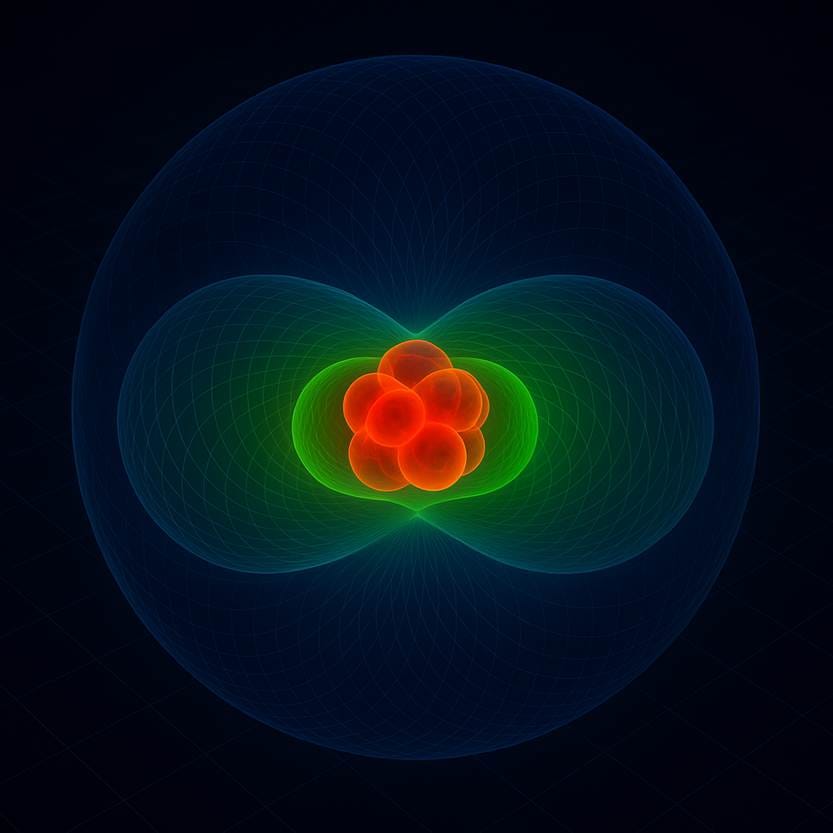
After carbon comes nitrogen (⁷N), where, according to QFG, an internal dynamic asymmetry appears for the first time - a "rotating" nucleus and a directed ψ-field.
This is the moment when the geometry of the field begins to breathe not only in amplitude but also in phase - spin precession of the entire node appears.
⚛️ The Nuclear Structure (φ)
Nitrogen has seven protons and seven neutrons - but they are arranged not symmetrically, rather as a slightly twisted hexagon with a central node.
This "spiral" form of the φ-field is the first realization of dynamic stability through rotation - the field does not merely remain in equilibrium; it stabilizes itself through motion.
For this reason, QFG regards nitrogen as the first dynamic node - balance not at rest, but in rhythm.
💫 The Electronic Structure (ψ)
Here ψ organizes into a double toroidal zone - a stable inner region (analogous to the helium envelope) and an outer region that begins to pulsate asymmetrically.
This outer ψ-zone is the source of chemical directionality - specific "bonding possibilities" appear, meaning three-dimensional directions in space.
In QFG, this is the geometric manifestation of valence - the resonant pathways along which φ and ψ can exchange phase without losing coherence.
🌈 Energy Picture
At the center (red) is a twisted hexagonal φ-node.
Around it is a green toroidal ψ-zone that is not symmetric, but has a "front" and a "back" phase.
The blue halo is the diffuse part of ψ, where the field emits phase information (wave direction), maintaining the stability of the rotation.
🌌 Interpretation according to QFG
Nitrogen is the first dynamically coherent element - in it, space is not merely form, but motion with its own phase.
This is the transition from "static harmony" (carbon) to "living rhythm" (nitrogen).
That is why nitrogen is fundamental to protein bonds - it carries the very pulsation of life within its structure.
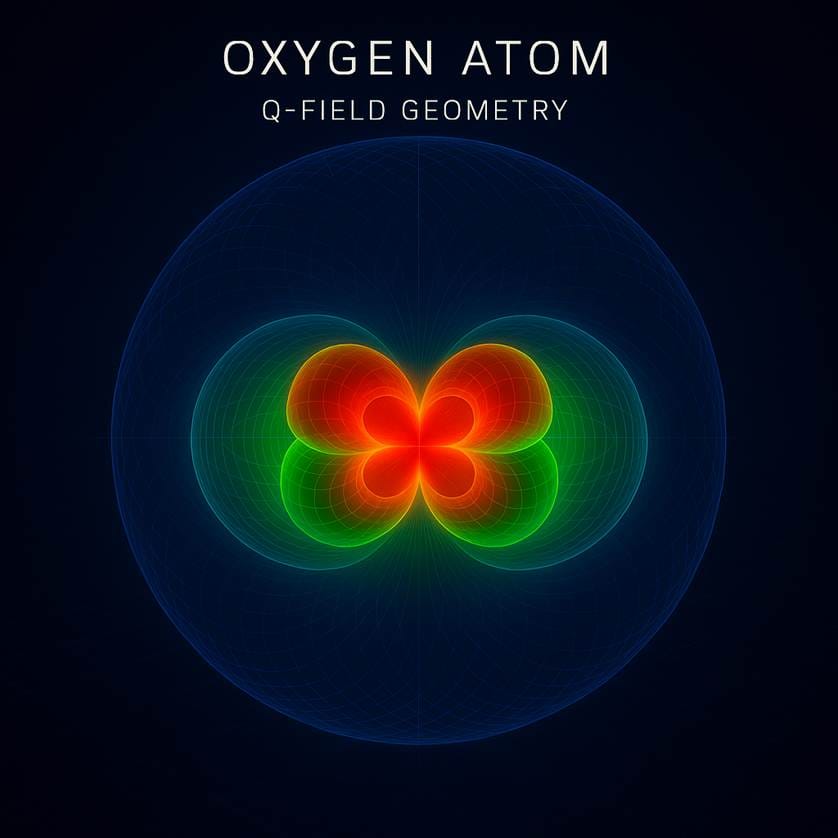
After nitrogen comes oxygen (⁸O), and according to QFG this is the first element in which the ψ-field becomes two-phase - resonance and anti-resonance,
while the φ-structure changes from a spiral into a double-toroidal configuration.
This is the moment when space begins to vibrate in a breathing mode - the same rhythm that later appears in all living systems.
⚛️ The Nuclear Structure (φ)
Oxygen has eight proton nodes and eight neutron nodes, interwoven into two symmetric φ-toroidal cores that share a common center.
This is the first double-resonant node - one φ-field "inhales," while the other "exhales" in an antiparallel phase.
As a result, the system maintains stability through a dynamic exchange of energy within itself rather than through rest.
💫 The Electronic ψ-Field
The ψ-field separates into three concentric levels:
- an inner level - fully coherent (analogous to the helium zone),
- a middle level - oscillating in antiphase with φ,
- an outer level - partially decoherent, but stabilized by synchronization of the two tori.
This configuration produces divalence - oxygen's ability to form two strong bonds (for example, in water and carbon dioxide).
In QFG, this is interpreted not as an electron deficiency, but as a phase mismatch between the ψ-waves.
🌈 Energy Picture
- Red-orange region: a double φ-node, stable and resonant;
- Green envelope: a zone of antiphase between φ and ψ - the element's "breathing";
- Blue halo: the field of exchange with the environment - here oxygen "accepts" and "releases" phase, which physically appears as strong reactivity.
🌌 QFG Interpretation
Oxygen is the first self-oscillating node of the field.
It is not merely stable - it is stable through rhythm.
Within it, φ and ψ continuously exchange, one becoming stronger as the other weakens.
This "breathing" of the Q-field is the same principle later observed in molecular biology - the pulsation of life.
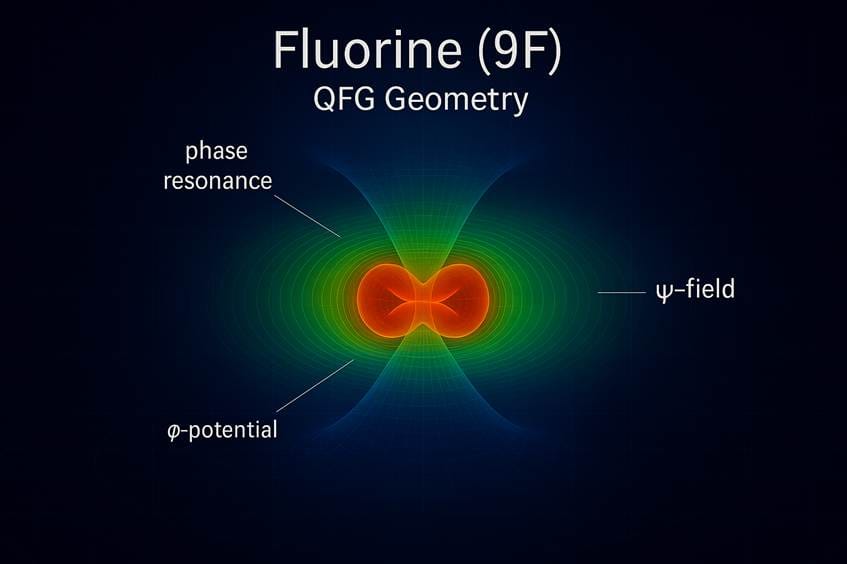
After oxygen comes fluorine (⁹F) - the first element in which the QFG field displays a directed phase shift and creates active polarity.
This is the boundary at which space no longer merely reacts, but initiates interaction.
⚛️ The Nuclear Structure (φ)
Fluorine contains nine proton nodes and ten neutron nodes, interwoven into an asymmetric double torus similar to oxygen, but with a slight phase rotation of one torus relative to the other.
This creates a field with a directed moment - a central "arrow" of the φ-potential that neutral elements do not possess.
Thus field polarity is born - the essence of what classical chemistry calls electronegativity.
💫 The Electronic ψ-Field
Fluorine's ψ-field has four layers, with a strongly compressed inner envelope and a pronounced external field.
The outer region is unstable and seeks coherence - this is precisely what makes fluorine so reactive.
From the QFG viewpoint, this is an attempt by the ψ-field to restore its phase symmetry by "drawing" energy from another field (for example, from hydrogen in HF).
🌈 Energy Picture
- At the center - a double φ-core with a clearly expressed phase tilt (red-yellow).
- The green zone - a strongly stressed ψ-resonance in which a "phase arrow" is created.
- The outer blue halo - elongated and directional; not spherical, but a directed cone of energy.
Thus fluorine is the first element with active field emission, capable of inducing changes in the structure of other nodes.
🌌 QFG Interpretation
Fluorine is a node of the seeking phase - its field is not complete, but is undergoing correction.
It "pulls" energy from its surroundings in order to restore balance.
In this sense, fluorine is a symbol of an entropic field that seeks order - a dynamic from which more complex interactions are born.
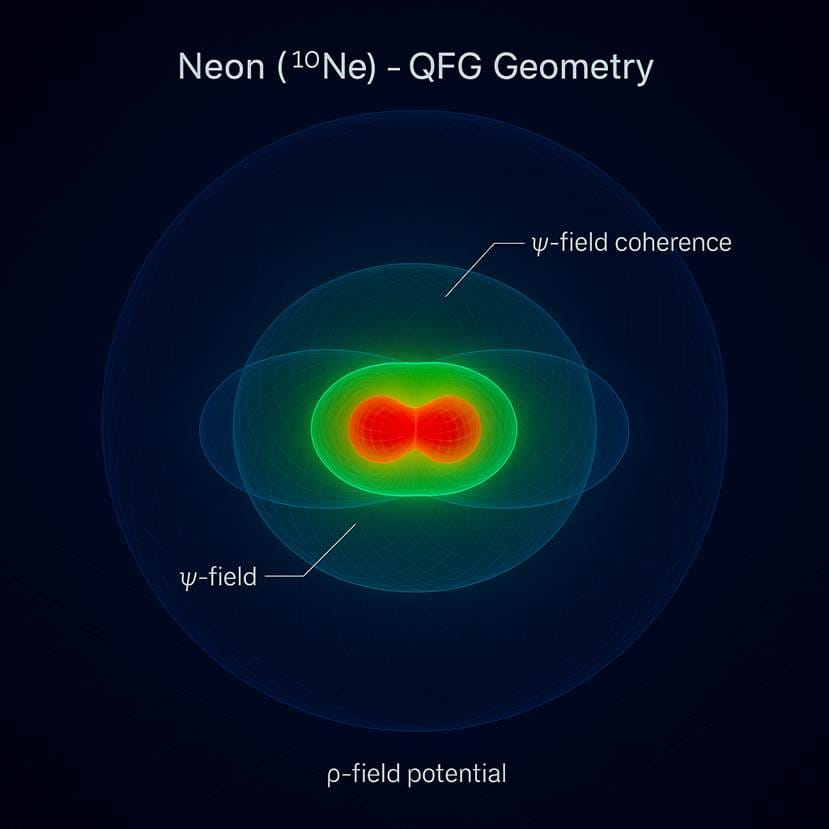
After fluorine comes neon (¹⁰Ne) - and here QFG theory reaches one of the most harmonious states of matter.
This is the first fully coherent double resonant node after helium, but now at a much higher level of complexity.
⚛️ The Nucleus (φ-Field)
Neon has 10 proton nodes and 10 neutron nodes arranged in a double tetra-toroidal configuration.
Imagine two mutually interwoven spheres of φ-potential vibrating in absolute phase -
one sets the inner rhythm, while the other stabilizes it through antiphase in the ψ-field.
The result is a completely balanced field that does not seek interaction with the external environment -
this explains neon's inertness by a purely geometric mechanism.
💫 The Electronic ψ-Field
Neon's ψ-field is doubly closed - it has an inner coherent layer (analogous to helium) and an outer layer phase-synchronized with φ.
The two layers behave as a single whole, in complete coherence, without phase deviations.
There are no "open" tori and no stresses - the ψ-phase rotates perfectly in a 4π resonance, making neon "phase-complete."
🌈 Energy Picture
- Red-orange region (φ): a double stable structure with complete phase;
- Green-blue region (ψ): an ideal double torus, fully symmetric;
- Blue halo: uniform, spherical, and directionless - complete equilibrium between φ and ψ.
This is the "quietest" node in the entire first ten elements - fully coherent and requiring no exchange.
🌌 QFG Interpretation
Neon is a perfect coherent node - phase and antiphase are in absolute agreement.
It is the first complete resonator of the Q-field - the "silence" after fluorine's storm.
Here space finds rest again, but at a higher level of organization.
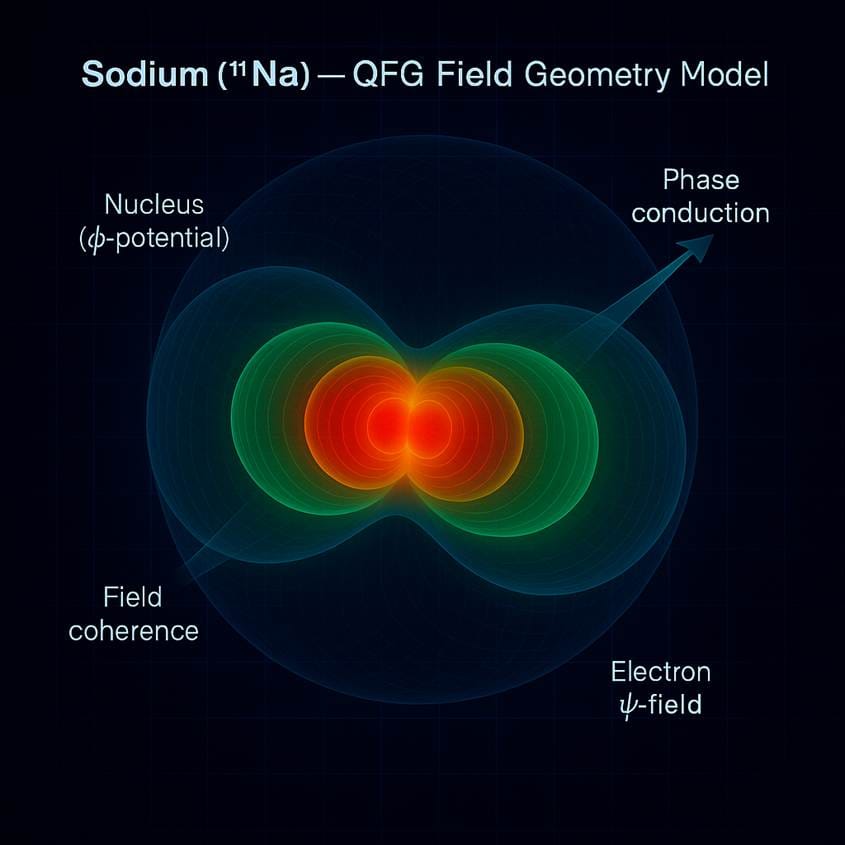
After neon comes sodium (¹¹Na) - the first representative of the externally open ψ-systems in QFG.
Here the field is no longer fully closed (as in neon), but is partially decoherent in its outer layer, giving rise to its ability to interact actively and transfer energy - the basis of its chemical activity.
⚛️ The Nuclear Structure (φ)
Sodium has 11 proton nodes and 12 neutron nodes arranged in a triple toroidal configuration - two inner, stable φ-zones (similar to neon's), and one outer, open φ-spiral.
This outer φ-spiral is the connecting component that allows the ψ-field to "flow" outward - it creates a phase bridge between sodium's field and other nodes (for example, chlorine in NaCl).
💫 The Electronic ψ-Field
Sodium's ψ-field has three layers:
- an inner layer (full coherence - similar to neon),
- an intermediate layer (partial synchronization with φ),
- an outer layer (open, emitting phase).
This outer layer is essential: QFG describes it as a dynamic transfer phase,
which does not lose energy but transports phase - and this is how the ionic bond arises.
🌈 Energy Picture
- Red-orange region: the inner φ-tori (stable).
- Green region: the transitional ψ-layer, partially phase-disordered.
- Blue halo: asymmetric, slightly "open" in one direction - emitting phase outward.
This is the first element with field emission that can be "switched on" and "switched off" by external excitation - which is why sodium glows at low energy (its yellow spectrum).
🌌 QFG Interpretation
Sodium is a transition between closed and living nodes.
In it, ψ is no longer fully coherent, but this incomplete coherence is precisely what allows it to transfer energy and form structures.
In a sense, it is the first conductor of phase information in the periodic table.
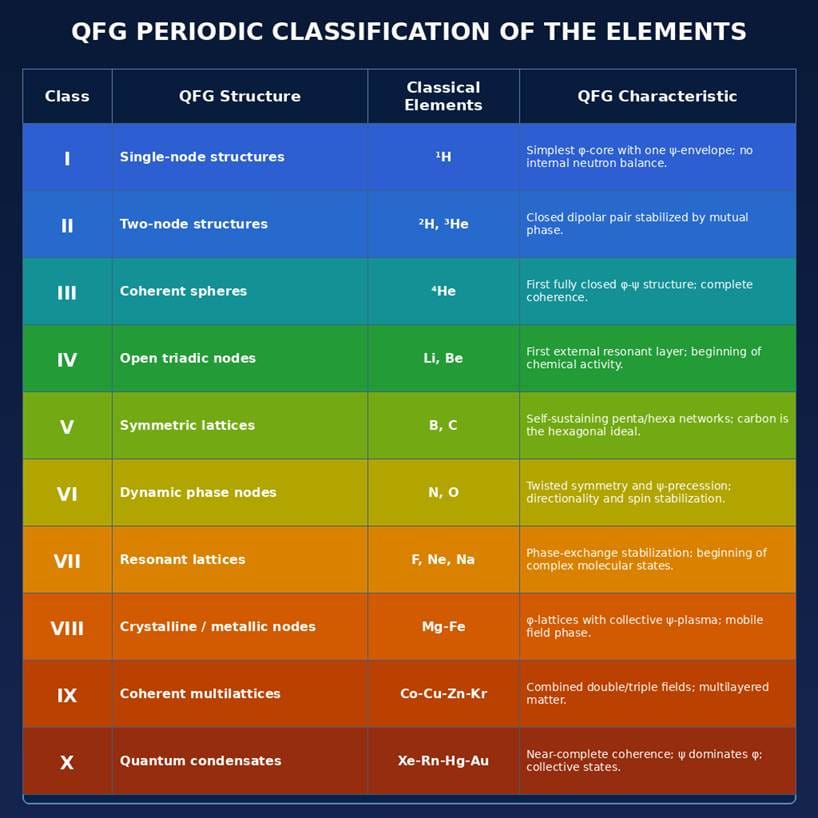
The QFG version of the Periodic Table - not merely as a chemical table, but as a geometric and field-based classification of nodes.
That is, the elements are arranged not by atomic number, but by the topology of their φ-ψ structures, their symmetries, and the way in which the Q-field self-organizes.
🧭 QFG Periodic Classification of the Elements
|
Class |
QFG Structure |
Classical Elements |
QFG Characteristic |
|
I. Single-node structures |
φ-core with one ψ-envelope |
¹H (hydrogen) |
The simplest node, a pure form of the φ-potential, without
internal neutron balance. |
|
II. Two-node structures |
φ+ψ pair (closed dipole) |
²H (deuterium), ³He |
A balanced dipolar node, stabilized through mutual phase. |
|
III. Coherent spheres |
fourfold symmetry φ⁴-ψ⁴ |
⁴He |
The first fully closed structure - complete coherence of φ
and ψ. |
|
IV. Open triadic nodes |
φ³ core, partially open ψ |
Li, Be |
Nodes with a first external resonant layer. The beginning
of chemical activity. |
|
V. Symmetric lattices |
penta- and hexa-connected nodes |
B, C |
The first self-sustaining network structures. Carbon is
the hexagonal ideal. |
|
VI. Dynamic nodes (phase nodes) |
twisted symmetry + ψ-precession |
N, O |
The nucleus begins to rotate. Directionality and spin
stabilization appear. |
|
VII. Resonant lattices (living) |
triple ψ-tori, polar bonds |
F, Ne, Na |
Stabilized through phase exchange. The beginning of
'living' molecular states. |
|
VIII. Crystalline and metallic nodes |
φ-lattices with a collective ψ-plasma |
Mg-Fe |
QFG interpretation of metals as 'field fluids' with a
mobile ψ-phase. |
|
IX. Coherent multilattices |
double or triple fields ψ(φ₁, φ₂, φ₃) |
Co-Cu-Zn-Kr |
Combined fields, the first stage toward multilayered
states of matter. |
|
X. Quantum condensates |
φ-plasma with a ψ-lattice |
Xe-Rn-Hg-Au |
A field in nearly complete coherence; ψ dominates over φ.
The beginning of collective states. |
🧠 Explanation of the Logic
- In the QFG table, the rows are not periods, but levels of self-organization - measures of the complexity of the φ↔ψ relationship.
- The classical "atomic number" reflects how many nodes (φ) participate, but what matters more is the topology in which they are interwoven.
- The transition from class I to X is not merely the addition of particles, but an evolution of space itself - from a local vibration (H) to field crystallization (gold, mercury, radon).
🌌 An Interesting Relationship
QFG periodicity can be expressed by a simple principle:
When the number of φ-nodes exceeds the topological capacity of ψ, a new layer of organization emerges.
This replaces the classical concept of "electron shells" with an actual field geometry.