Q-Field Geometry: The mathematical apparatus of BSM-SG
Here is the entire QFG theory (Q-Field Geometry) — from Principle I to Principle XI — written descriptively, without heavy formulas, so that to be understandable for philosophers, and for bankers, and for physicists. I will hold the language clear, will insert only the most necessary concepts and will give intuitive examples.
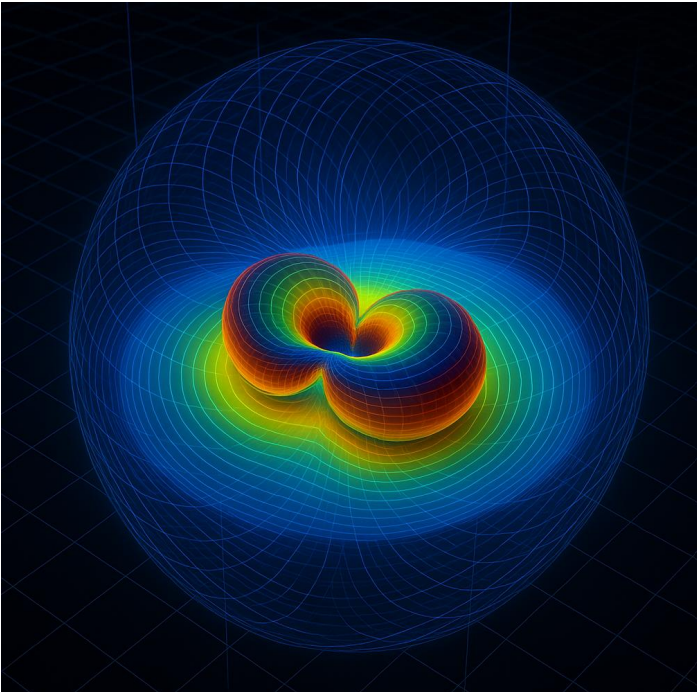
Principle I — What is “reality” according to QFG
Idea: The Universe not empty space with " objects " inside. It is continuous quantum field (we call it it Q- field) with internal orientation and "density". This field is like environment in which is form all phenomena: particles, light, forces, even itself feeling for space and time.
Intuition: Imagine you Ocean. Waves, eddies and whirlpools are local "forms" of the same water. Here "water" is the Q- field, and the stable structures inside are that which we call "particles" and "matter".
Principle II — From where "matter" comes
Idea: The matter are stable nodes (vortices) in the Q- field. They are no "balls", but stable, intertwined configurations – such as knots in a rope, which no can yes is untie without yes is broke the rope.
Why is it important: Such knot there is name (topological "charge ") and its own energy/mass. The “electron- type” node is the simplest stable knot. The more complex knots would describe heavier or composite objects.
Principle III — Forces are geometry on the field
Idea: That which we feel as forces (for example electricity and magnetism), not are separate things, but regularities in orientation and phase on the Q-field. When the phase changes in space, arises that which we know as electromagnetic field.
Intuition: If the compass is immersed in a liquid with "direction" , differences in this direction create effects that we describe as forces.
Principle IV — Dynamics and reserved dimensions
Idea: Q- field follows the principes nature chooses the most economical "road". From here bare coming the equations on traffic and laws for conservation (energy, momentum, electrical charge).
Practically: There are good certain "currents" and "charges" that no is lose. This does the theory predictable and consistent with the familiar physics.
Principle V — Spin and Statistics from the topology
Idea: The spin (e.g. "1/2" for electron) and this whether something is holds as fermion or boson are imposed "outside" and follow from knots. The simplest knot gives exactly behavior as on electron: at full rotation on the system is receives characteristic "minus" sign - this is a fermion.
Consequence: No is imposes yes, we postulate back – he falls as consequence from geometry on the knot.
Principle VI — Phases of the " vacuum " and cracks
Idea: And the Q- field there are "states" on rest (phases), which can be different by orientation or "hardness". The transition between phases opens or closes energy cracks (how "hard" it is) yes you excite definitely flickering).
Practical: From this the "masses" depend on collective excitement, and the possibility yes is observing specific resonances in experiments.
Principle VII — Observation, noise and efficiency parameters
Idea: The real measurements are medium over small scales and times. The faster details on the Q- field leave traces as corrections on the constants (for example a little different "dielectricity" of vacuum in a resonator).
Practical: In our model this is reflected through two "effective" multipliers:
- the one controls the "hardness" of itself field,
- the other – the effective strength on electromagnetic response in complex environments.
They are calibrating once to " electron-type" the knot " and then is use predictive.
Principle VIII — Scale and Renormalization
Idea: The constants in one effective theory can slightly yes depend on energy / length scale (what we look at: atoms, cavities, space).
Practically: We fix the scale at electron (mass and Compton his length). Thus we "calibrate" the model and each deviation in others experimental conditions become verifiable.
Principle IX — Gravity as answer on the energy on the field
Idea: Where there are energy and voltage in the Q- field, there space-time slightly bends. This is the standard idea on the general relativity, but with explicit source – our field.
Practically: On laboratory scales the effects are microscopic. It is useful for cosmological reflections and about completeness on the theory.
Principle X — Compliance and Verifiability
Idea: QFG is valid if:
- In " calm " mode reproduces the standard physics (electromagnetism, familiar particles)
- Gives new, falsifiable predictions in controlled conditions (e.g. high - Q optical cavities, ionic traps).
Examples for predictions:
- microscopic, but systematic frequency shifts in resonators, which grow linear with energy density in the cavity.
- narrow " topological " resonant line, characteristic for the simplest knot;
- small, but measurable drifts at Rabi frequency at Yb⁺ ion, dependent from fashion and polarization.
Principle XI — Translation to real units and laboratory scenarios
Idea: We give clear map how our dimensionless parameters is translating to SI and how yes is calculate the effects in specific installations.
Two canonical scenes:
- Optical cavity (high Q): how the frequency on fashion is displaces at change on the stored energy and volume on fashion. The effect is of level parts on billion (ppm) at contemporary stable lasers - measurable.
- Ionen trap with ^171Yb ⁺: how Rabi frequency and phase is influence from the geometry / polarization and the " hardness " of field. Expected displacements from order Hertz at 100 kHz Rabi – completely within range of Ramsey/echo techniques.
Why is QFG useful (outside of physics)
- Philosophical: Reconciles " substance " and " emptiness " - both are appearances on one and the same field. The " particle " is stable knot on form, no separate object.
- For bankers / managers: Gives working frame for predictable, small, but measurable effects in photonics and quantum technologies. This is a base for our IP- free innovation (through protective publications) and for products: stable lasers, sensors, quantum elements.
- For engineers / scientists: There is standard model (calibrated to electron), clear parameters for setup and path to software (QFG-DFT “Molecular Creator”) and hardware (Yb platform).
What we have already " nailed "
- Clear ontology (Principle I) and mechanism for matter (II).
- The forces as geometry (III), dynamics with reservations (IV).
- Spin / Stats from the knot (V).
- Phases and gaps (VI), measurement and effective parameters (VII).
- Large-scale calibration (VIII), gravity compatibility (IX).
- Compliance + counterfeitable effects (X).
- SI map and two “reference” experiments (XI).
How it we use immediately
- Molecular Creator (QFG-DFT): functional with several additional " smart " terms that catch long-distance phase effects. Practical: better design on molecules / materials with set optical / electronic properties.
- Yb quantum platform: we measure the predicted mini-shifts as function from quality on cavity, volume and polarization – direct inspection on QFG.
Ethics and accessibility
We publish openly (defensive publication), so that nobody yes don't " lock in " the idea behind patents. QFG remains accessible for scientists, engineers and industry – open base, on which yes is builds.