Resonant Plasma Capacitor with Dynamic Dielectric Medium
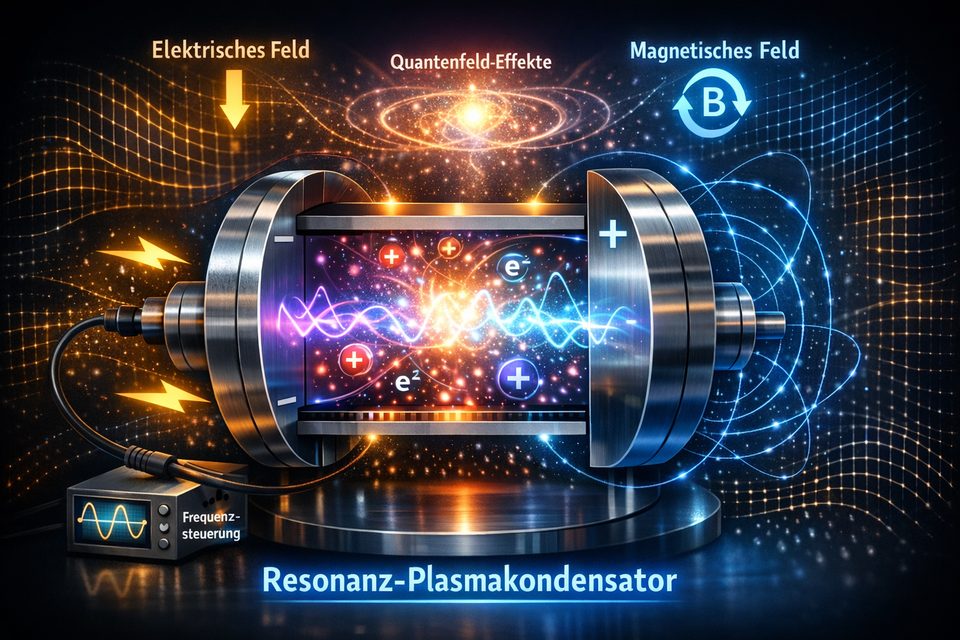
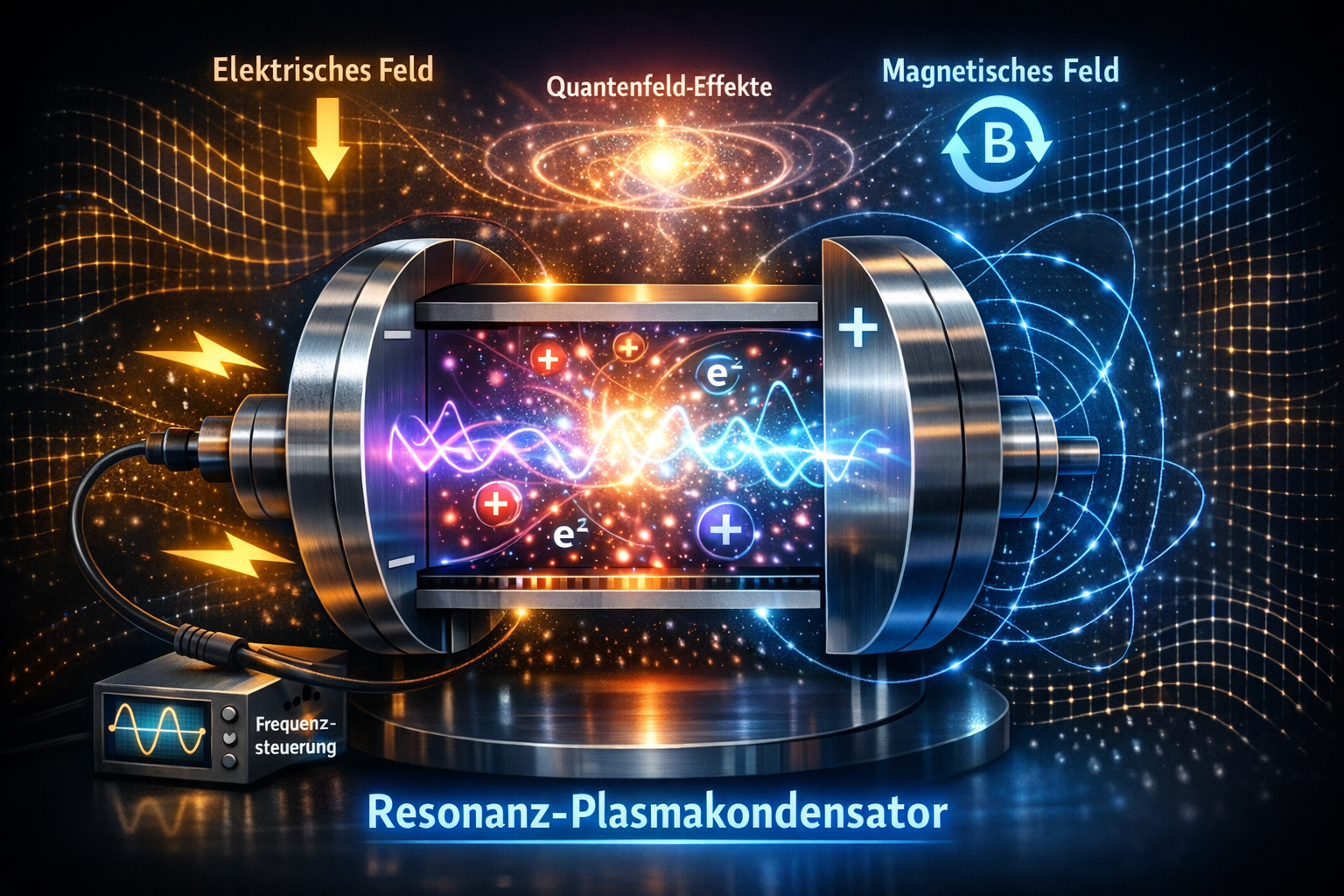
A Conceptual Architecture for Field-Coupled Energy Storage and Plasma Interaction
Abstract
Conventional capacitors store electrical energy through electrostatic charge separation across a passive dielectric medium. While this principle has proven reliable for over a century of electrical engineering, it inherently limits the dynamic interaction between stored energy and surrounding electromagnetic processes.
In this paper we introduce the concept of a Resonant Plasma Capacitor (RPC), a novel energy storage architecture in which the dielectric medium is replaced by a dynamic ionized environment capable of interacting with electric and magnetic fields in a frequency-dependent manner.
Unlike classical capacitors, whose capacitance is defined by static material parameters, the RPC exhibits an emergent effective capacitance determined by plasma state, electromagnetic excitation, and system geometry. Under resonant conditions the device can act not only as an energy storage element but also as a field-coupled energy interface, enabling interaction between electrical power systems and plasma dynamics.
The proposed architecture may have implications for advanced energy buffering, plasma control systems, and high-frequency field-coupled energy devices.
1. Introduction
Electrical energy storage is traditionally implemented through electrochemical systems (batteries), mechanical systems (flywheels), or electrostatic systems (capacitors). Among these technologies, capacitors provide the highest power density and fastest response time, but their energy density remains limited due to the constraints of static dielectric materials.
The fundamental energy stored in a capacitor is given by
E=12CV2E = \frac{1}{2} C V^2E=21CV2
where CCC is capacitance and VVV is voltage.
In conventional systems the capacitance is determined by
C=εAdC = \varepsilon \frac{A}{d}C=εdA
with dielectric permittivity ε\varepsilonε, electrode area AAA, and separation distance ddd.
This classical model assumes that the dielectric medium behaves as a passive and linear material with constant permittivity. However, many physical systems—particularly plasmas, electrolytes, and ionized gases—exhibit strongly nonlinear electromagnetic behavior that cannot be adequately described by this simplified model.
Recent advances in plasma physics and high-frequency electromagnetic systems suggest that a new class of energy storage devices may be possible in which the dielectric medium actively participates in the energy dynamics.
The Resonant Plasma Capacitor (RPC) presented here explores such a possibility.
2. Concept of a Dynamic Dielectric Medium
The key departure from classical capacitor design is the replacement of the passive dielectric with a dynamic medium composed of charged particles.
Possible realizations include:
- partially ionized gas
- plasma discharge environments
- electrolytic ion media
- molecular systems with mobile charge carriers
In these systems the effective dielectric response is not constant but depends on multiple parameters:
εeff=f(frequency,field strength,ion density,temperature)\varepsilon_{eff} = f(frequency, field\ strength, ion\ density, temperature)εeff=f(frequency,field strength,ion density,temperature)
This implies that the capacitance of the device becomes
Ceff=f(f,E,ni,T)C_{eff} = f(f, E, n_i, T)Ceff=f(f,E,ni,T)
where
- fff = excitation frequency
- EEE = electric field strength
- nin_ini = ion density
- TTT = temperature
Thus the capacitance is no longer a fixed material constant but an emergent property of the system state.
3. Resonant Operation Regime
Traditional capacitors operate in a charge–discharge mode driven by direct current or low-frequency alternating signals. In contrast, the Resonant Plasma Capacitor is designed to operate in a resonant excitation regime.
The system is driven by a combination of
- DC bias field
- high-frequency AC excitation
- controlled electromagnetic field geometry
The resulting system dynamics can be represented as a coupled field system:
E(t),B(t),ni(t)E(t), B(t), n_i(t)E(t),B(t),ni(t)
Under appropriate conditions the plasma medium can support collective oscillations, including:
- electron plasma oscillations
- ion acoustic waves
- electromagnetic cavity modes
When the excitation frequency approaches these natural modes, strong energy coupling occurs between the external electrical circuit and the plasma medium.
This leads to several observable phenomena:
• increase in effective capacitance
• nonlinear current–voltage behavior
• phase shifts in impedance
• enhanced energy exchange between fields and medium
4. Architecture of the Resonant Plasma Capacitor
The conceptual architecture of the RPC consists of four primary subsystems.
4.1 Electrode Structure
Two conductive electrodes form the boundaries of the energy storage region. Their geometry may vary depending on the application:
- planar electrodes
- coaxial cylindrical electrodes
- toroidal or cavity geometries
The electrode configuration determines the spatial distribution of the electric field.
4.2 Plasma or Ion Medium
The region between electrodes contains the dynamic dielectric medium.
Possible media include:
- low-pressure noble gas plasma
- electrolytic fluid systems
- partially ionized molecular gases
The plasma density and ionization fraction determine the electrical properties of the device.
4.3 Excitation and Frequency Control
The system is driven by an external excitation circuit capable of producing controlled electromagnetic fields.
Typical components include:
- RF signal generator
- DC bias supply
- impedance matching network
- frequency control electronics
This subsystem allows the device to be operated near resonant conditions.
4.4 Field Interaction Region
Inside the capacitor volume the electric and magnetic fields interact with the plasma medium.
The energy exchange can be described as a coupled system involving:
- electric field energy
- magnetic field energy
- kinetic energy of charged particles
- collective plasma oscillations
This interaction region is what fundamentally differentiates the RPC from conventional capacitors.
5. Functional Behavior
The Resonant Plasma Capacitor may exhibit three simultaneous functional roles.
Energy Storage Element
The device stores electrical energy through charge separation and field energy within the plasma medium.
Field Sensor
Changes in plasma density, electromagnetic environment, or electrode geometry modify the impedance of the system, allowing it to act as a sensitive detector of electromagnetic conditions.
Energy Coupling Interface
The RPC can serve as a dynamic interface between power electronics and plasma systems, enabling controlled energy transfer between electrical circuits and plasma processes.
6. Potential Applications
Although still conceptual, the architecture may find applications in several areas:
- high-power plasma systems
- advanced pulsed power electronics
- electromagnetic energy buffering
- plasma-assisted chemical processes
- experimental field-coupled energy devices
Further theoretical and experimental investigation will be required to evaluate the practical performance limits of such systems.
7. Conclusion
The Resonant Plasma Capacitor represents a conceptual extension of classical capacitor technology in which the dielectric medium becomes an active participant in the energy dynamics of the device.
By introducing a dynamic ionized medium and operating the system near resonant electromagnetic conditions, it may be possible to create a new class of energy storage and field-coupled devices with properties not accessible to conventional electrostatic capacitors.
Future research will focus on experimental validation, modeling of plasma-field interactions, and exploration of practical engineering implementations.