Revisiting the Hydrogen Spectrum through the Lens of BSM-SG
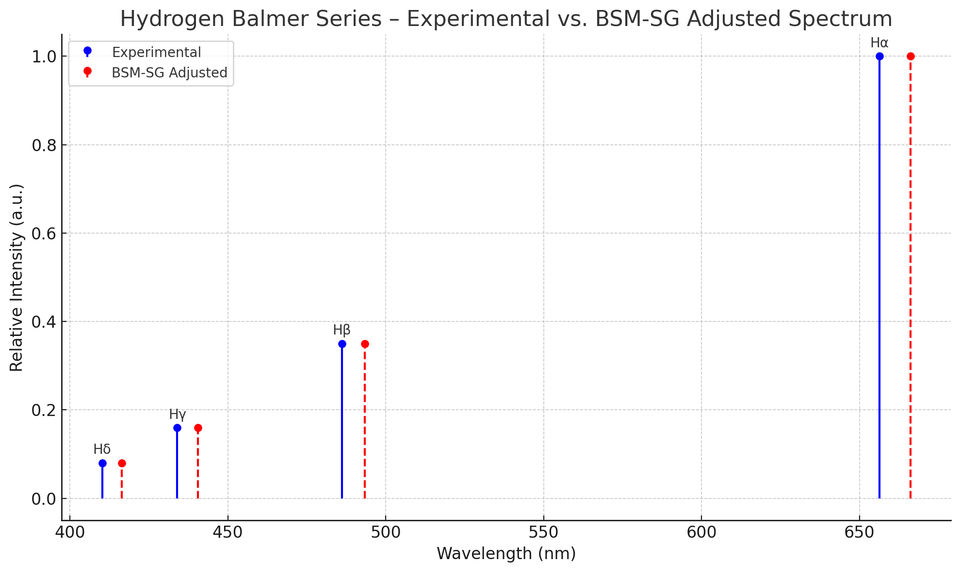
🔬 Revisiting the Hydrogen Spectrum through the Lens of BSM-SG (Revised Edition)
Abstract
The Basic Structures of Matter – Super Gravitation (BSM-SG) framework proposes an alternative physical interpretation of atomic structure, without contradicting the experimentally validated predictions of quantum mechanics. Rather than treating particles as point-like or rigid objects, BSM-SG considers them as stable equilibrium configurations emerging from the interaction between internal structural pressure and the external pressure of a pervasive cosmic lattice.
In this context, atomic spectra are not redefined, but reinterpreted. The observed energy levels are viewed as resonant states of pressure-stabilized structures. This perspective preserves the accuracy of existing models while opening a pathway toward a deeper physical understanding and potential experimental exploration.
1. Introduction
The hydrogen atom has long served as a cornerstone of modern physics. Its spectral lines are measured with extraordinary precision and are accurately described by quantum mechanical models.
The purpose of this work is not to challenge these results, but to explore whether an alternative physical interpretation may exist beneath the mathematical formalism.
The BSM-SG framework introduces a different ontological perspective: instead of treating particles as abstract entities governed solely by probabilistic wavefunctions, it considers them as physical structures stabilized within a dynamic medium — the cosmic lattice.
2. Conceptual Foundation of BSM-SG
In the BSM-SG model, space is not empty. It is structured and characterized by a background medium capable of exerting a form of pressure.
Within this framework:
- Matter emerges as localized stable configurations within this medium
- Stability arises from equilibrium between internal structural pressure and external lattice pressure
- Boundaries of particles are not fixed geometrical surfaces, but dynamic equilibrium interfaces
This leads to a reinterpretation of fundamental properties:
- Mass may be viewed as an integral of energy (pressure) density across a stable configuration
- Radius corresponds to the equilibrium boundary where internal and external pressures balance
- Particle identity is determined by the stability conditions of this configuration
3. Atomic Structure in the Pressure-Boundary Model
Applying this concept to the hydrogen atom:
The electron is not treated as a point particle orbiting the nucleus, but as a stable configuration within a structured field environment.
The allowed states of the system correspond to resonant equilibrium modes of this configuration.
Thus:
- Discrete energy levels arise naturally as stable resonant states
- Transitions between levels correspond to reconfiguration of the pressure-balanced structure
- Spectral lines reflect the intrinsic resonance properties of the system
Importantly, this interpretation does not alter the predicted frequencies. Instead, it offers a deeper physical picture of why discrete states exist.
4. Consistency with Experimental Spectra
Hydrogen spectral lines are known with extremely high precision, and small deviations from idealized models are typically explained by well-established effects such as pressure shifts, environmental interactions, and relativistic corrections.
The BSM-SG framework does not attempt to replace these explanations at this stage.
Instead, it is fully consistent with the observed spectra and aims to reinterpret the underlying physical mechanism responsible for the stability of the observed states.
5. Implications of the Pressure-Boundary Interpretation
If particles are indeed stabilized by a balance of internal and external pressures, several implications arise:
- The properties of particles may depend weakly on the surrounding environment
- External conditions could influence stability in subtle ways
- The vacuum itself may play an active role in defining physical constants
This suggests that what is traditionally considered “empty space” may have a measurable influence on physical systems.
6. Potential Experimental Signatures
While the effects are expected to be extremely small, the pressure-boundary model suggests possible experimental signatures:
- Weak frequency shifts under controlled environmental variation
- Subtle anisotropic behavior depending on orientation
- Small variations in coherence times
- Sensitivity to background fields or structural conditions
These effects would not contradict existing measurements, but could appear as residual signals beyond standard explanations.
Careful experimental design and high-precision instrumentation are required to investigate these possibilities.
7. Toward a Testable Framework
The strength of the BSM-SG interpretation lies in its potential testability.
Rather than proposing immediate revisions to well-established results, the framework encourages:
- Identification of small residual effects
- Development of controlled experiments
- Exploration of resonance-based systems
This approach allows gradual validation or falsification without conflict with existing physics.
8. Discussion
The pressure-boundary model provides a conceptual bridge between classical structure and quantum behavior.
It offers:
- A physical interpretation of quantization
- A structural origin of particle stability
- A potential link between microscopic systems and a larger cosmological medium
However, the model is still in a formative stage and requires further mathematical development and experimental verification.
9. Conclusion
The BSM-SG framework offers a reinterpretation of atomic structure in which particles are viewed as stable equilibrium configurations within a structured medium.
Without contradicting the experimentally verified hydrogen spectrum, this perspective introduces a deeper physical layer, where mass, radius, and energy levels emerge from pressure balance and resonance.
Future work will focus on refining the mathematical formulation and identifying experimentally accessible effects that could support or refute this model.
10. Minimal Mathematical Model of the Pressure-Boundary Hypothesis
To make the BSM-SG interpretation more explicit, we introduce a minimal phenomenological model in which an elementary particle is treated as a stable equilibrium structure embedded in a structured background medium.
The central assumption is that particle stability is determined by a balance between:
- an internal structural pressure generated by the particle’s own field configuration, and
- an external background pressure associated with the cosmic lattice.
Let the effective particle boundary be defined by a radius

. The equilibrium condition is then written as:

where

is the internal pressure profile and

is the effective pressure exerted by the surrounding structured medium.
10.1 Energy Density and Effective Mass
Assume that the particle is associated with an effective energy density

. Then the total effective mass may be written as
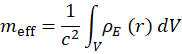
or, under spherical symmetry,
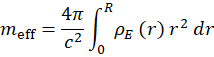
In this interpretation, mass is not merely an abstract intrinsic parameter, but the integrated result of a stable localized energy-pressure configuration.
10.2 Pressure Balance and Boundary Stability
A stable particle boundary requires not only equality of pressures at

, but also local restoring behavior against perturbations. This may be expressed through an effective radial potential

, such that equilibrium occurs at

with stability condition
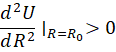
Equivalently, one may define an effective pressure mismatch function

and require

with a restoring sign structure around

This makes the particle radius

a dynamic equilibrium boundary rather than a rigid geometric size.
10.3 Resonant States
In the pressure-boundary picture, excited states may be interpreted as resonant modes of the same stable structure. Let the equilibrium radius undergo a small perturbation:

Then, to first approximation, the dynamics may be written as

where:

is the local restoring coefficient.

is an effective damping term,

is an effective inertial parameter of the structural mode,
The corresponding natural frequency is

In this minimal interpretation, discrete energy states may be associated with allowed structural resonance modes, with transition energies of the form

where

corresponds to the transition between two admissible modes of the pressure-stabilized configuration.
This does not replace standard quantum predictions, but provides a structural interpretation for why only discrete states are observed.
10.4 Sensitivity to Background Conditions
If the external lattice pressure is not perfectly constant, but varies weakly with orientation, gravitational environment, or background field structure, then

which leads to a corresponding perturbation of the equilibrium radius

and therefore to small changes in resonance frequencies:

Thus, the model predicts that extremely weak but measurable residual effects could appear as:
- frequency shifts,
- linewidth variations,
- coherence-time fluctuations,
- anisotropic or time-dependent signatures.
These effects are expected to be very small and should be treated as a working hypothesis for experimental investigation.
11. Diagram: Particle as a Pressure Boundary
You can include the following as the conceptual figure caption and description.
Figure Title
Particle as a Pressure-Stabilized Boundary in the BSM-SG Framework
Figure Caption
A schematic representation of an elementary particle in the BSM-SG framework. The inner region corresponds to a localized structural energy-pressure configuration. The outer region represents the surrounding cosmic lattice, characterized by an effective background pressure. The particle boundary is not treated as a rigid surface, but as a dynamic equilibrium interface defined by the balance between internal structural pressure and external lattice pressure. Small perturbations of this boundary give rise to resonant modes, which may be associated with discrete energy states.
Suggested Diagram Layout
You can give this to a designer, or I can turn it into a clean figure afterward.
Cosmic Lattice / Background Medium
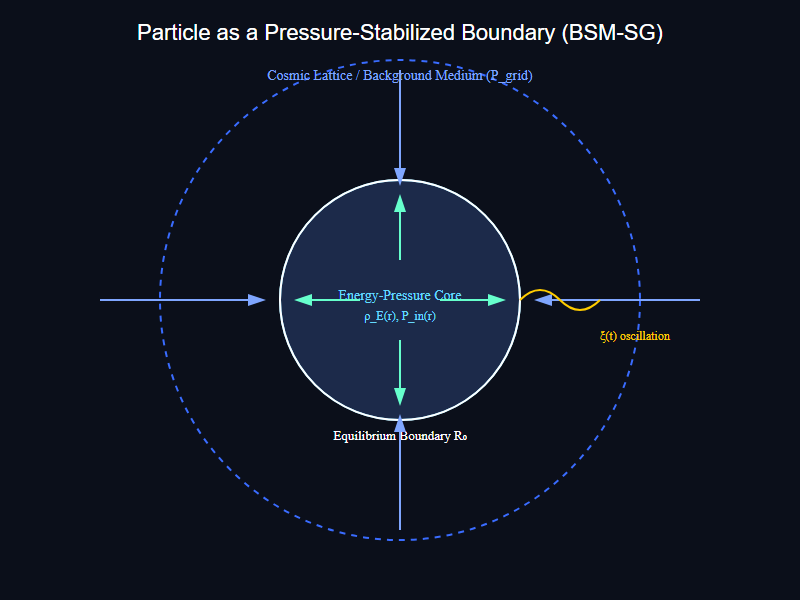
Small boundary oscillation:
R(t) = R0 + ξ(t)
Cleaner Visual Logic for the Final Graphic
The final polished figure should contain:
- arrows pointing inward from the outer region:
external lattice pressure - arrows pointing outward from the inner region:
internal structural pressure
a small sinusoidal perturbation at the boundary labeled:
resonant mode

a highlighted shell labeled:
equilibrium boundary

an inner spherical or quasi-spherical core labeled:
Localized energy-density structure

an outer field labeled:
Cosmic lattice / structured vacuum / background pressure

12. Experimental Appendix: Toward a Test of the Pressure-Boundary Model
12.1 Objective
The purpose of this experimental appendix is not to claim direct proof of the BSM-SG framework, but to identify possible observable consequences of the pressure-boundary interpretation of matter.
If particles and resonant states are stabilized, even weakly, by interaction with a structured external medium, then carefully designed experiments may reveal small residual effects not fully attributable to known environmental factors.
12.2 Testable Working Hypothesis
Working hypothesis:
Stable resonant systems may exhibit extremely weak frequency, phase, linewidth, or coherence variations if the surrounding background medium contributes to their equilibrium structure.
Null hypothesis:
All such observed variations are fully explained by known influences such as temperature, pressure, electromagnetic interference, vibration, instrumental drift, and material imperfections.
12.3 Primary Observable Quantities
The most relevant observables are:
- orientation-dependent residuals
- time-dependent periodic residuals
coherence time variation

linewidth variation

phase drift

resonance frequency drift

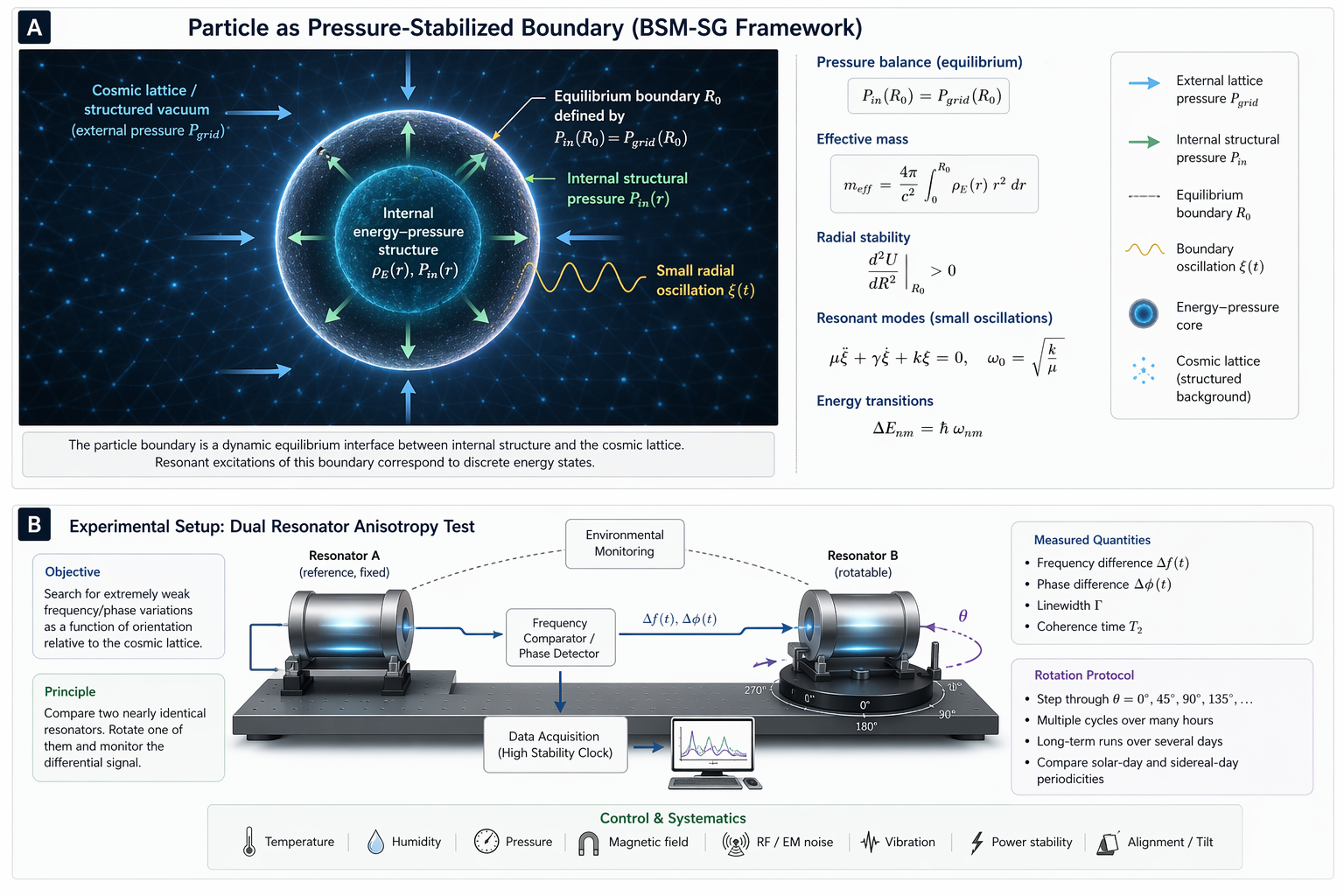
12.4 Recommended First Experiment: Dual Resonator Anisotropy Test
A practical first test is a dual resonator comparison experiment.
Setup
Two closely matched resonant systems are used:
- Resonator A: fixed orientation
- Resonator B: mounted on a rotation platform
Possible implementations include:
- optical cavities,
- microwave cavities,
- quartz or crystal oscillators,
- ESR/EPR/NMR resonant systems,
- ultra-stable laser reference systems.
Measurement Principle
Let the two resonators produce frequencies

and

. The measured quantity is the differential signal

If the pressure-boundary hypothesis has a real physical effect, one possible signature would be a weak modulation of

as Resonator B changes orientation or as the Earth rotates relative to a preferred background structure.
Expected Search Signatures
The experiment should search for:
- azimuth-dependent modulation,
- sidereal-period residuals,
- phase-locked weak frequency shifts,
- repeatable non-random structure after environmental subtraction.
12.5 Environmental Monitoring and Controls
Because the expected signal is extremely small, simultaneous monitoring is essential:
- temperature
- humidity
- barometric pressure
- magnetic field
- RF background
- vibration / acceleration
- power-supply stability
- mechanical tilt / alignment
The goal is to eliminate or model all standard sources of drift before interpreting any residual signal.
12.6 Orientation Protocol
A recommended rotation protocol is:
- repeat cycles over many hours
- perform long-duration acquisition over multiple days
- compare solar-day and sidereal-day periodicity
hold at

,

,

,

A true orientation-dependent background effect should show repeatable structure across cycles.
12.7 Secondary Experimental Routes
Beyond the dual-resonator test, the pressure-boundary model may also motivate:
A. Coherence-Time Experiments
Measure whether

or

times in controlled systems show unexplained residual modulation after accounting for known noise sources.
B. Interferometric Phase Experiments
Use optical or microwave interferometry to search for weak orientation-dependent phase drift.
C. Resonant Solid-State Systems
Investigate narrow resonance lines in crystals or rare-earth systems for subtle environmental residuals.
These routes may provide a more accessible first step than direct atomic spectroscopy.
12.8 Data Analysis Strategy
The analysis should proceed conservatively:
- Model known environmental correlations
- Remove thermal and instrumental drift
- Examine residuals in time and frequency domain
- Search for repeatable periodicities
- Test whether observed structure tracks orientation or sidereal phase
- Replicate under altered shielding and geometry
A candidate signal should only be considered meaningful if it is:
- repeatable,
- statistically robust,
- stable across runs,
- not reducible to known systematic effects.
12.9 Interpretation Limits
Even a positive residual would not by itself prove the full BSM-SG framework. It would only indicate that an additional structured influence may be present.
Conversely, a null result would not necessarily falsify the entire theory, but would constrain the scale at which such effects could exist.
For this reason, the proposed experiments should be interpreted as hypothesis-testing steps rather than final demonstrations.
12.10 Experimental Outlook
The pressure-boundary model becomes scientifically useful only if it leads to measurable consequences. Its value, therefore, lies not merely in conceptual reinterpretation, but in motivating precision experiments capable of distinguishing structured-background effects from ordinary environmental noise.
Future work should focus on:
- deriving stronger quantitative predictions,
- estimating signal magnitude,
- identifying optimal resonant platforms,
- and narrowing the gap between theoretical interpretation and laboratory observability.