Portable Quantum Encryption System
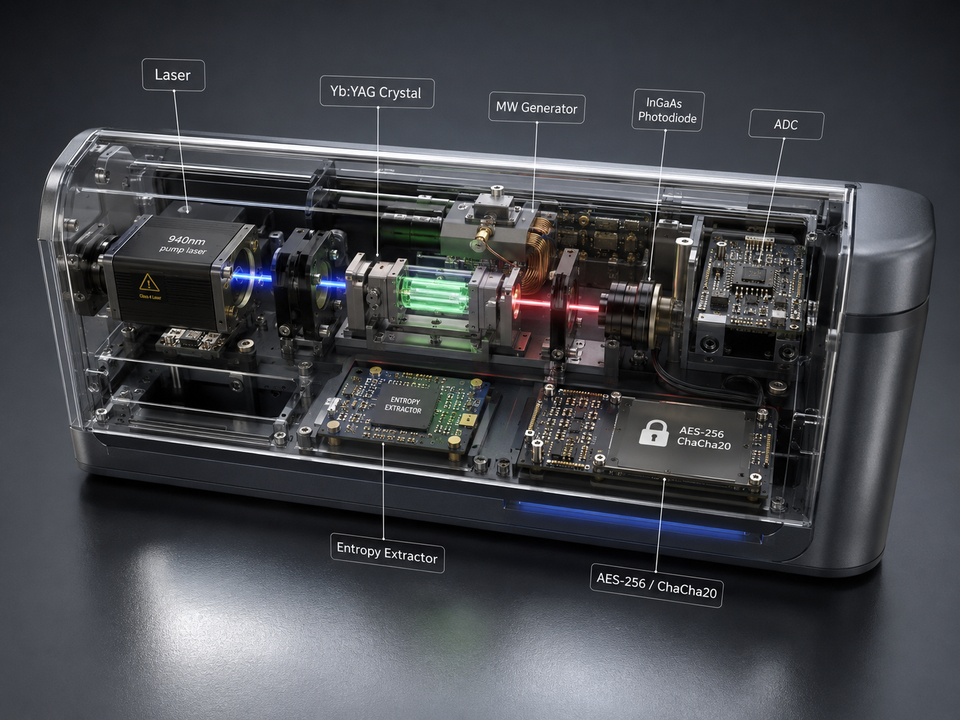
A Portable Yb:YAG-Assisted Photonic Entropy Source for Embedded Cryptographic Systems
Conceptual Architecture, Security Model, and Experimental Validation Protocol
Viktor Stefanov Pronchev
Independent Researcher, Bulgaria, July 2026
|
MANUSCRIPT STATUS: CONCEPTUAL
ARCHITECTURE AND FALSIFIABLE VALIDATION PROGRAM |
Abstract
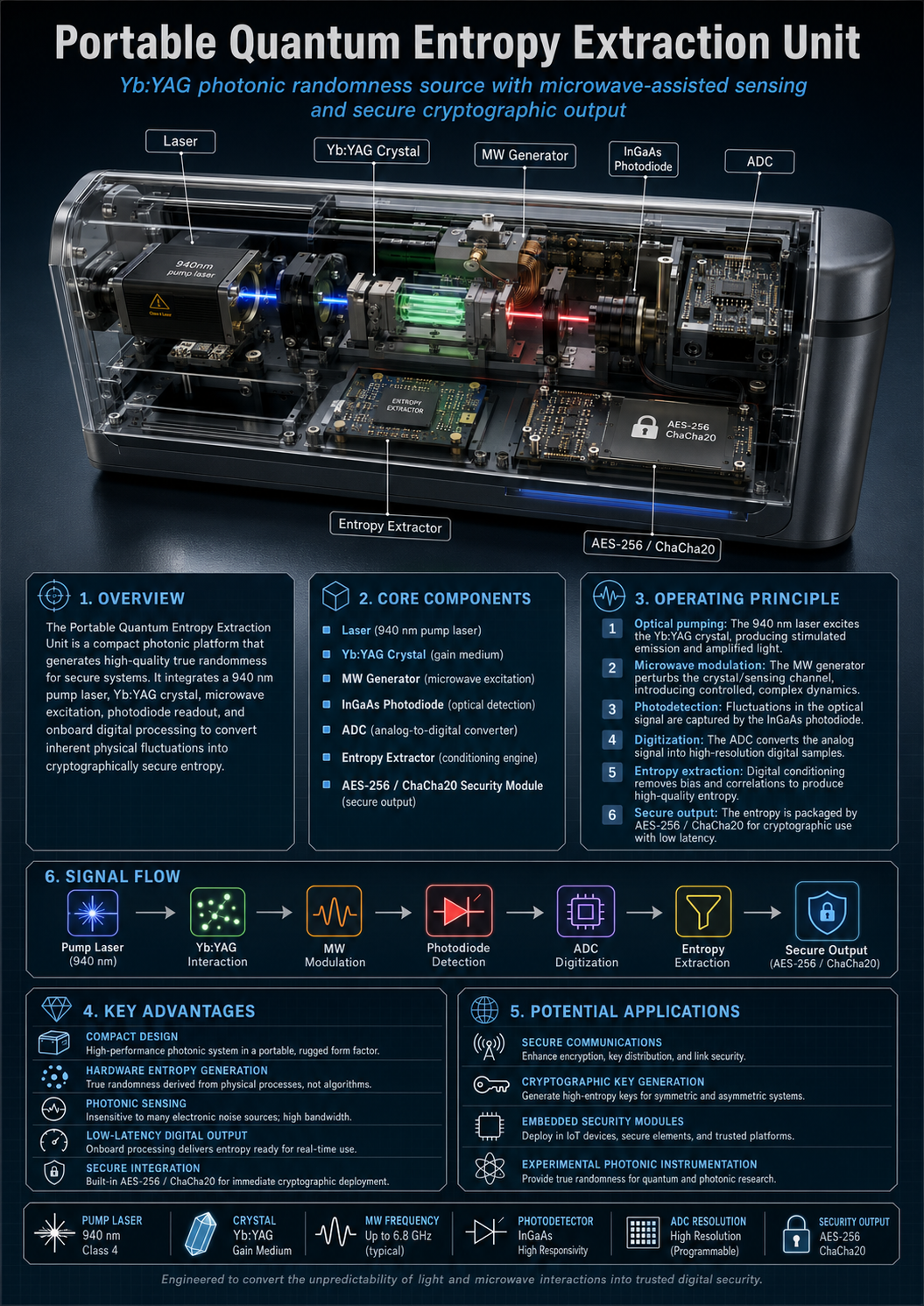
This paper proposes a portable photonic entropy-source architecture that combines optical pumping of an ytterbium-doped yttrium aluminum garnet (Yb:YAG) medium, optional radio-frequency or microwave interrogation, InGaAs photodetection, high-resolution digitization, online health tests, and cryptographic conditioning. The engineering objective is not to treat a laser as intrinsically secure, but to isolate, quantify, and continuously monitor a physically unpredictable component of the detected optical fluctuations. The design is compatible with established entropy-source practice: the raw signal is modeled as a mixture of quantum-origin fluctuations, classical optical dynamics, electronic noise, and environmental perturbations; a conservative conditional min-entropy bound is estimated; and a vetted randomness extractor feeds a deterministic random bit generator or a cryptographic key-management module. A separate Q-Field Geometry (QFG) hypothesis is included as an optional research layer. It predicts that dual-drive resonance conditions may produce reproducible changes in higher-order fluctuation statistics and coherence boundaries after thermal and classical nonlinear effects are removed. This QFG contribution is explicitly separable from the conventional photonic entropy-source baseline and is considered falsified if it does not improve predictive power or entropy certification. The paper defines the system architecture, threat model, statistical pipeline, calibration plan, pass/fail criteria, and limitations required before the device can be called a quantum random number generator.
Keywords: photonic entropy source, quantum random number generation, Yb:YAG, min-entropy, randomness extraction, NIST SP 800-90B, embedded cryptography, Q-Field Geometry
1. Introduction
Cryptographic systems require unpredictable seeds, nonces, salts, challenges, and long-term keys. The security of modern ciphers such as AES and ChaCha20 does not compensate for a predictable key-generation process. A hardware entropy source must therefore be evaluated as a complete measurement system rather than as a visually impressive physical effect. The relevant questions are: What physical variable is sampled? Which portion of the observed variance is unpredictable to an adversary? How is the entropy lower-bounded? How are failures detected during operation? And how is the raw source safely composed with cryptographic conditioning?
The proposed device uses a pumped Yb:YAG optical medium and an InGaAs photodetector because this combination supports compact near-infrared instrumentation and permits multiple candidate entropy mechanisms, including spontaneous-emission fluctuations, amplified spontaneous emission, laser phase noise near threshold, and resonance-dependent intensity fluctuations. The architecture is deliberately modular. The Yb:YAG stage is not assumed to produce certified quantum entropy merely because it is optical; certification depends on the measured source model, the quantum-to-classical noise ratio, conditional min-entropy, extractor construction, and continuous health testing.
2. Scope and Scientific Claim
The paper makes three progressively stronger claims, only the first of which is assumed at the design stage:
1. Engineering claim: a compact optical platform can generate a high-bandwidth raw noise signal and deliver conditioned random bits to an embedded security module.
2. Entropy claim: after calibration and adversarial modeling, a defensible lower bound can be assigned to the conditional min-entropy of the raw samples.
3. Quantum claim: a quantified fraction of the min-entropy originates from a quantum process such as spontaneous emission or optical phase diffusion, rather than from uncontrolled classical noise.
The term quantum random number generator is reserved for the third claim after successful validation. Before that point the apparatus should be described as a photonic hardware entropy source.
3. Physical and Instrumental Architecture
|
Subsystem |
Proposed role |
Scientific
requirement |
|
Pump laser (approximately 940-980 nm) |
Excites the Yb:YAG medium or drives a near-threshold
optical regime. |
Power, wavelength, linewidth, relative-intensity noise, and
temperature must be monitored. |
|
Yb:YAG optical medium |
Provides gain, fluorescence, spontaneous-emission, or
resonance-dependent fluctuations. |
Doping, length, crystal orientation, temperature, and
optical transition must be specified. |
|
Optical filters and isolators |
Select the spectral band and suppress feedback or parasitic
reflections. |
Insertion loss and out-of-band rejection must be measured. |
|
RF/microwave interrogation |
Optional modulation or spectroscopic perturbation channel. |
Frequency must be derived from measured crystal
spectroscopy; a nominal 6.8 GHz label is not a universal Yb:YAG resonance. |
|
InGaAs photodiode and transimpedance amplifier |
Converts optical fluctuations into an analog electrical
signal. |
Bandwidth, linearity, saturation, dark noise, shot-noise
calibration, and common-mode rejection are required. |
|
ADC and clock |
Digitizes the analog signal. |
Effective number of bits, aperture jitter, differential
nonlinearity, and clock coupling must be characterized. |
|
Entropy-estimation and extractor logic |
Bounds min-entropy, applies health tests, and extracts
near-uniform bits. |
Extractor parameters must be derived from a conservative
source model. |
|
DRBG and cryptographic output |
Provides operational key material and nonces. |
Composition must follow an approved random-bit-generation
architecture. |
4. Conventional Source Model
Let the digitized raw sample be represented by
X_k = Q_k + C_k + E_k,
where Qk denotes the target quantum-origin contribution, Ck includes classical optical dynamics and environmental coupling, and Ek represents detector, amplifier, ADC, and clock noise. The security problem is not to maximize the total variance of Xk. It is to lower-bound the unpredictability of Xk conditioned on information E available to an adversary.
H_min(X|E) = -log2 p_guess(X|E).
Conditional min-entropy is the operative security quantity.
A physical model is required to estimate the maximum probability that an adversary can guess the next raw sample. Classical components that are measurable, controllable, or externally injectable must be treated as side information rather than counted as entropy. The extractor output length m for n raw samples must remain below the validated entropy budget, with a security margin for model uncertainty and nonstationarity.
5. Candidate Quantum Mechanisms
5.1 Spontaneous-emission and amplified-spontaneous-emission fluctuations
Spontaneous emission is a natural candidate because photon-emission events have an irreducibly probabilistic quantum component. In a gain medium, amplified spontaneous emission can produce high-bandwidth intensity fluctuations. However, the measured signal also contains gain dynamics, pump noise, detector noise, and optical feedback. A credible entropy analysis therefore requires a validated emission-detection model and a measured quantum-to-classical noise ratio.
5.2 Laser phase diffusion
Near threshold or in a pulsed/interferometric configuration, spontaneous emission can randomize the optical phase. Phase-noise QRNGs are well established, but the proposed hardware must include an interferometric or quadrature-sensitive readout if phase diffusion, rather than intensity noise, is the intended entropy variable.
5.3 Shot-noise or balanced-detection mode
A balanced detector can suppress common classical intensity noise and expose shot-noise-dominated fluctuations. This may be scientifically cleaner than a single photodiode, although it increases component count and calibration complexity.
6. Entropy Extraction and Cryptographic Composition
The proposed signal-processing sequence is:
4. Acquire raw ADC samples without undocumented smoothing, clipping, or automatic gain control.
5. Apply startup and continuous health tests to detect stuck values, excessive repetition, distribution collapse, or abrupt environmental changes.
6. Estimate the validated min-entropy per sample under the selected physical and adversarial model.
7. Apply a cryptographic randomness extractor, such as a Toeplitz-hash construction or another vetted strong extractor, using an output length consistent with the entropy bound.
8. Use the extracted bits to instantiate or reseed an approved deterministic random bit generator.
9. Deliver keys, nonces, or seed material to AES-256, ChaCha20, or higher-level protocols through a protected interface.
AES-256 and ChaCha20 do not “make” the source random. They protect and expand already validated entropy through a deterministic construction. The system must fail closed when health tests indicate that the entropy source has left its validated operating region.
7. Threat Model
|
Threat |
Mechanism |
Required
control |
|
Optical injection |
An attacker injects coherent light or modulates the pump
path. |
Optical isolation, input monitoring, spectral filtering,
enclosure sensors, and injection tests. |
|
RF injection |
External RF modifies the gain medium or analog electronics. |
Shielding, RF monitoring, susceptibility testing, and
cross-channel alarms. |
|
Thermal manipulation |
Temperature changes alter gain, linewidth, and detector
response. |
Crystal, laser, photodiode, and enclosure temperature
telemetry. |
|
ADC or clock fault |
Sampling artifacts create deterministic patterns. |
Independent clock monitoring, ADC self-test, and redundancy
where required. |
|
Software compromise |
Entropy estimates or health tests are bypassed. |
Measured boot, signed firmware, immutable health-test
logic, and audit logging. |
|
Backdoor or biased extractor |
Post-processing creates a hidden predictable output. |
Public algorithms, reproducible builds, known-answer tests,
and independent review. |
8. QFG/BSM-SG Research Layer
Q-Field Geometry represents matter through a complex field Ψ, density ρ = Ψ†Ψ, an orientation field n, gauge structure, and finite coherence regions. In this language, the Yb:YAG crystal is treated not only as a gain medium but as a driven field-geometric resonator. The optional hypothesis is that selected dual-drive conditions may reorganize the local coherence boundary and change fluctuation statistics in a way that is not reducible to ordinary thermal, Kerr, gain-saturation, or electronic effects.
S_QFG = ∫ d4x [L_QFG(Ψ, A_μ, n) + L_drive + L_readout].
A minimal instrument-level QFG observable can be written schematically as
ΔK_QFG(Δf, P_opt, P_RF) = K_meas - K_classical,
where K is a vector of measured statistics such as linewidth, power spectral density, skewness, kurtosis, autocorrelation, mutual information, and conditional min-entropy. The QFG term is supported only if it predicts reproducible residual structure across independent devices and survives model-selection penalties against conventional nonlinear optics.
8.1 Falsification rule
If a conventional laser-plus-detector model explains all observed detuning, sideband, linewidth, and noise changes within uncertainty, the QFG entropy-enhancement hypothesis is rejected. The device may still remain useful as a conventional photonic entropy source.
9. Experimental Validation Program
|
Phase |
Experiment |
Primary
outputs |
Pass criterion |
|
A |
Dark/electronic baseline with optical path blocked |
ADC histogram, PSD, autocorrelation, min-entropy bound |
Electronic contribution quantified and stable. |
|
B |
Pump-only optical noise across power and temperature |
Optical PSD, detector linearity, classical-noise transfer |
Validated operating region without saturation. |
|
C |
Quantum-origin calibration |
Quantum-to-classical noise ratio or validated emission
model |
Positive conservative quantum entropy bound. |
|
D |
Extractor validation |
Bias, correlations, entropy budget, known-answer tests |
Output length below validated entropy; no hidden
preprocessing. |
|
E |
Adversarial testing |
Optical, RF, thermal, supply, and clock injection |
Detection or fail-closed behavior for all tested attacks. |
|
F |
QFG dual-drive test |
Residual statistics versus detuning and geometry |
Pre-registered reproducible residual beyond classical
model, or null result. |
10. Performance Metrics
· Validated conditional min-entropy per raw ADC sample.
· Sustainable extracted-bit rate under worst-case environmental conditions.
· Quantum-to-classical noise ratio and uncertainty interval.
· Online health-test false-positive and false-negative rates.
· Recovery behavior after source failure or environmental excursion.
· Resistance to optical, RF, thermal, and power-supply injection.
· Energy consumption, warm-up time, size, and temperature sensitivity.
· Long-term stability and unit-to-unit reproducibility.
11. Discussion
The proposed platform is technically plausible as a photonic entropy-source research instrument, but the current architecture should not be marketed as a certified quantum cryptographic module. The strongest conventional path is to select one entropy mechanism, design the optical readout specifically around that mechanism, build a quantitative source model, and validate the resulting min-entropy. A single-ended photodiode monitoring a pumped crystal may generate abundant noise while still yielding a weak security claim if the noise cannot be separated from classical dynamics.
The use of a rare-earth-doped crystal creates interesting opportunities for optical and microwave spectroscopy, but it also introduces slow population dynamics, spectral hole burning, thermal lensing, pump transfer noise, and sensitivity to crystal quality. These effects are valuable scientific observables but must not be counted automatically as secret entropy. The QFG layer is scientifically acceptable only as a pre-registered residual hypothesis evaluated after the conventional model has been exhausted.
12. Limitations
· No experimental data from the pictured device are currently available.
· The exact Yb:YAG composition, isotope content, optical geometry, and microwave transition are unspecified.
· The illustrated microwave frequency is conceptual and must not be treated as a universal Yb:YAG resonance.
· No conditional min-entropy value or secure bit rate has yet been demonstrated.
· No third-party entropy-source validation, cryptographic certification, or penetration testing has been completed.
· The QFG contribution is a research hypothesis, not an established source of quantum randomness.
13. Conclusion
A portable Yb:YAG-assisted photonic entropy source can be investigated with established quantum-randomness and cryptographic-engineering methods. The decisive requirement is not the presence of a laser, a crystal, or a security processor, but a transparent chain from a physical source model to a conservative entropy bound, a vetted extractor, continuous health monitoring, and fail-secure cryptographic composition. QFG/BSM-SG may be used to formulate additional resonance-dependent predictions, but those predictions must remain independent of the baseline entropy claim and must be rejected if conventional nonlinear optics explains the observations. This separation allows the same prototype to produce useful engineering results even if the speculative field-geometric hypothesis is not supported.
Acknowledgements
The author acknowledges Prof. Stoyan Sargoytchev for the BSM-SG framework and the ongoing discussions on resonance, Cosmic Lattice interpretations, and experimentally testable Q-Field Geometry models.
Author Biography
Viktor Stefanov Pronchev is an independent researcher from Bulgaria with professional experience in IT security, computational systems, and security engineering. His research interests include Q-Field Geometry, BSM-SG-inspired computational models, photonic instrumentation, entropy-source validation, and reproducible experimental workflows.
References
[1] M. Sönmez Turan et al., Recommendation for the Entropy Sources Used for Random Bit Generation, NIST Special Publication 800-90B, 2018. https://csrc.nist.gov/pubs/sp/800/90/b/final
[2] M. Herrero-Collantes and J. C. Garcia-Escartin, Quantum random number generators, Reviews of Modern Physics 89, 015004 (2017). https://doi.org/10.1103/RevModPhys.89.015004
[3] J. Yang et al., Randomness quantification for quantum random number generation based on detection of amplified spontaneous emission noise, 2020. https://arxiv.org/abs/2008.11886
[4] C. K. Duda et al., Development of a high min-entropy quantum random number generator, 2023. https://www.osti.gov/biblio/1975653
[5] J. Li et al., Quantum random number generation based on phase reconstruction, 2024. https://arxiv.org/abs/2401.08325
[6] T. Böttger et al., Optical spectroscopy and decoherence studies of Yb3+:YAG at 968 nm, Physical Review B 94, 045134 (2016). https://doi.org/10.1103/PhysRevB.94.045134
[7] V. S. Pronchev, QFGv2: Minimal QFG Lagrangian, resonator tests, and measurement program, working manuscript, 2026.
[8] V. S. Pronchev, Thermodynamic Extension of Q-Field Geometry: A Relative-Entropy Action for Emergent Gravity, working research draft, 2026.
[9] S. Sargoytchev, Basic Structures of Matter - Supergravitation Unified Theory, third edition, 2025.