Solution to the Finite Physical Boundary Problem of the Excited Hydrogen Atom in the BSM-SG/QFG Resonance Framework
Solution to the Finite Physical Boundary Problem
of the Excited Hydrogen Atom
in the BSM-SG/QFG Resonance Framework
Essay manuscript v0.4 - prepared for Prof. Stoyan Sargoytchev and Ivan Kostadinov review
Author: Viktor Stefanov Pronchev, Independent Researcher, Bulgaria
Framework: Basic Structures of Matter - Supergravitation (BSM-SG) and Q-Field Geometry (QFG)
Version: v0.4, July 2026
Abstract
The standard hydrogen spectrum is one of the greatest quantitative successes of modern atomic physics. The Rydberg formula correctly reconstructs the main spectral series, while the Bohr interpretation relates the principal quantum number n to an orbital radius r_n = a0 n^2. In the formal limit n -> infinity, this radius becomes unbounded, while the atom approaches ionization. Standard quantum mechanics treats this correctly as the transition from bound states to the continuum, but the physical image of an indefinitely expanding material orbit remains conceptually unsatisfactory if one seeks a finite structural model of the atom.
This essay proposes a finite physical boundary interpretation of the excited hydrogen atom in the BSM-SG/QFG resonance framework. In BSM-SG, the hydrogen atom is described using the Bohr surface, Cosmic Lattice (CL) space, quasishrunk CL-space quantum conditions, and photon emission as release of pumped CL-space energy. In QFG, this picture is translated into a finite coherence-boundary model in which hydrogen is a proton-centered field-geometric resonance system rather than a point electron on unlimited classical orbits.
The numerical reconstruction uses the standard infinite-mass Rydberg constant and applies the hydrogen finite-mass correction. In BSM-SG/QFG terminology, this correction is interpreted as a finite-nucleus / CL-pumping efficiency factor. The central claim is not that standard spectroscopy is wrong, but that BSM-SG/QFG offers a finite physical interpretation of the same spectral structure and suggests testable high-n consequences.
Keywords
Hydrogen spectrum; BSM-SG; Q-Field Geometry; Bohr surface; finite physical boundary; Rydberg constant; Cosmic Lattice; high-n Rydberg states; resonance system.
1. Introduction: The finite-boundary problem
The hydrogen spectrum is accurately described by the Rydberg formula. However, the older Bohr image attaches the quantum number n to a radius that grows as n^2. Formally, this creates a conceptual problem: if n is allowed to increase without bound, the associated radius also grows without bound.
This essay does not claim that standard quantum mechanics fails mathematically. It does not. In the standard theory, n -> infinity is the ionization limit, where the electron is no longer a bound atomic state. The problem addressed here is different: the classical-orbit picture does not provide a finite physical boundary for the excited atom.
BSM-SG/QFG offers a different physical interpretation. The excited hydrogen atom is not an unlimited ladder of material electron orbits. It is a finite resonance system with a physical boundary: the BSM-SG Bohr surface / SG-CL boundary, translated in QFG as a finite coherence boundary of the proton-electron field configuration.
2. Standard spectrum and Rydberg formula
The empirical hydrogen spectrum is described by the Rydberg formula, where R_H is the hydrogen-specific Rydberg constant, n_i is the initial principal quantum number, n_f is the final principal quantum number, and n_i > n_f. The Lyman, Balmer, and Paschen series correspond to transitions ending at n_f = 1, 2, and 3 respectively.
The usual energy-level form is E_n = -13.6 eV / n^2. This spectral formalism is successful. The present work preserves that success but gives it a finite-boundary resonance interpretation.
1/lambda = R_H (1/n_f^2 - 1/n_i^2)
E_n = -13.6 eV / n^2
3. The Bohr-radius issue
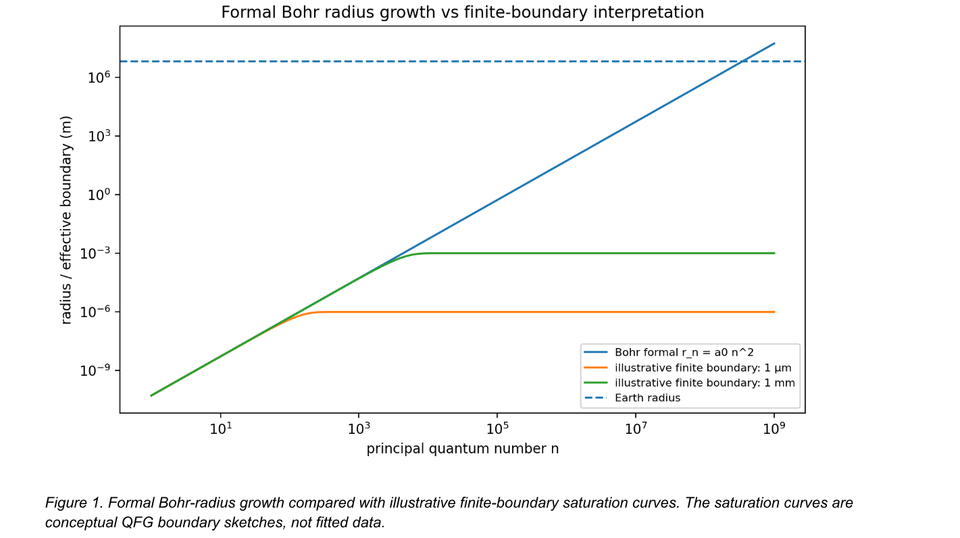
In the Bohr model, r_n = a0 n^2. Using a0 = 5.29177e-11 m and Earth radius approximately 6.371e6 m, the formal Bohr radius equals Earth's radius only at approximately n = 3.47e8. This is not intended as a realistic atomic state. It is a conceptual illustration: if the orbit picture is taken literally, the excited atom has no finite physical boundary.
The BSM-SG/QFG proposal is: high n does not mean an unlimited material orbit; it means a higher resonance mode approaching the finite boundary of the atom's field-geometric structure.
r_n = a0 n^2
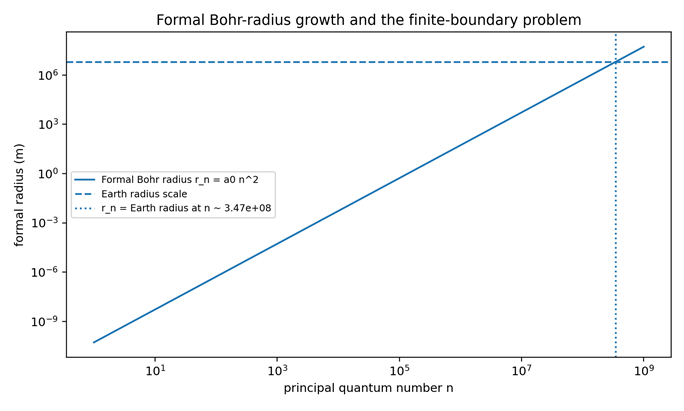
Figure 1. Formal Bohr-radius growth: the classical-orbit image becomes physically misleading at very high n.
4. BSM-SG interpretation: Bohr surface and CL-space
In BSM-SG, hydrogen is not modeled only as a point electron around a point proton. The electron system, the proton core, and the Cosmic Lattice (CL) space form a structured physical system.
The key BSM-SG concept for this article is the Bohr surface. It is treated as a physically meaningful boundary region. Outside the Bohr surface, the proton-electron system may approximately behave like a far-field charge/neutral object. Inside the surface, the point-charge approximation becomes insufficient, and the finite proton-core structure and CL-space quantum conditions become important.
The BSM-SG interpretation can be summarized as:
Rydberg structure -> electron harmonic motion -> CL-space resonance condition -> finite Bohr surface
This supplies a physical basis for replacing the infinite-radius orbital picture with finite resonance modes inside the Bohr surface.
5. BSM-SG derivation notes included in v0.4
This section is intentionally concise because the broader BSM-SG/QFG background should be placed on BSM-SG-computing and cited in the references, rather than overloading the essay.
5.1 Bohr surface as finite boundary
The Bohr surface is used here as the finite physical boundary of the hydrogen resonance system. It separates the external far-field behavior from the internal CL-space quantum domain.
5.2 Rydberg constant as first SPM harmonic / CL parameter
In the BSM-SG reading, the Rydberg constant is not only an empirical spectroscopic constant. It is associated with the electron's first SPM harmonic quantum motion and with the CL-space parameters that support the hydrogen resonance structure.
5.3 Quasishrunk CL-space inside the Bohr surface
Inside the Bohr surface, BSM-SG describes electron motion as occurring in an E-field affected CL domain. The SPM wavelength relevant to quantum conditions is reduced relative to free CL space. This is described as quasishrunk quantum space. This does not mean that the literal CL node distance or proton dimensions shrink. It means that the quantum conditions are expressed in an effective internal scale.
lambda'_SPM < lambda_SPM
5.4 Balmer series as finite internal orbit family
The Balmer series is interpreted as a family of finite internal resonance/orbit configurations between the proton core and the boundary orbit. The important point is that the series is constrained by a finite Bohr-surface geometry rather than by an indefinitely expanding material orbit.
5.5 Photon emission as pumped CL-space energy release
Photon emission is interpreted as a finite-duration release of pumped CL-space / SG-related energy when the electron system drops from a higher resonance condition to a lower one. A spectral line is therefore a transition in a coupled proton-electron-CL field system.
6. QFG translation: finite coherence boundary
QFG translates the BSM-SG physical picture into field-geometric language. Hydrogen is modeled as a proton-centered topological node coupled to a surrounding electronic resonance mode. The electron is not treated as a literal small object following a classical path. It is modeled as a stable psi-field resonance coupled to a proton-centered phi-field structure.
The QFG representation contains three conceptual layers:
1. central proton node;
2. toroidal electronic resonance region;
3. finite coherence boundary where the psi-field relaxes into the background Q-medium.
This coherence boundary is dynamic, not rigid. It may deform with excitation, phase, and environmental conditions, but it remains a finite equilibrium boundary.
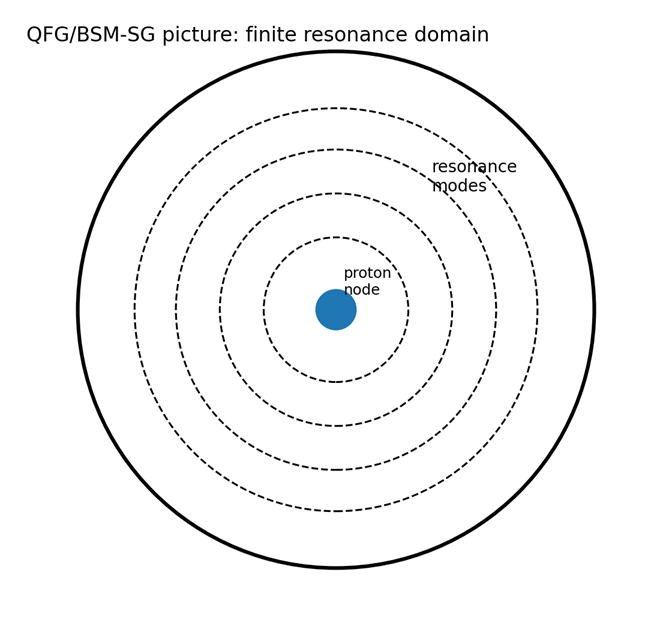
Figure 2. QFG translation: hydrogen as a finite proton-centered resonance domain.
7. Minimal QFG formalization
QFG provides a mathematical and computational layer for simulation. A minimal QFG description uses a complex two-component spinor Psi, density rho = Psi^dagger Psi, a U(1) gauge field A_mu, a field tensor F_mu_nu, and an orientation vector n.
A reduced radial energy model can be written schematically as:
E(R) ~ A/R + B R + C R^3
A finite stable boundary appears when:
dE/dR = 0
In the weak-C limit, the characteristic radius behaves as:
R_* ~ sqrt(A/B)
For this article, the equation is not presented as a final derivation of hydrogen. It is a compact QFG translation of the BSM-SG concept: stable field configurations can have finite preferred radii instead of unlimited material orbits.
8. Numerical reconstruction: finite-mass / CL-pumping correction
The infinite-mass Rydberg constant R_infinity represents the spectral scale for an idealized infinitely heavy nucleus. Hydrogen requires a finite-mass correction because the proton is not absolutely fixed. Standard physics calls this the reduced-mass correction. In BSM-SG/QFG language, the same factor is interpreted as a finite nucleus / CL-pumping efficiency factor.
eta_M = M / (M + m_e)
R_M = R_infinity eta_M
For hydrogen: R_infinity = 10973731.568157 m^-1, eta_H = 0.999455679425, and R_H = 10967758.340280 m^-1.
This factor shifts the infinite-mass wavelengths to the hydrogen-specific values in Table 1. The correction is small but systematic: approximately 544.6 ppm.
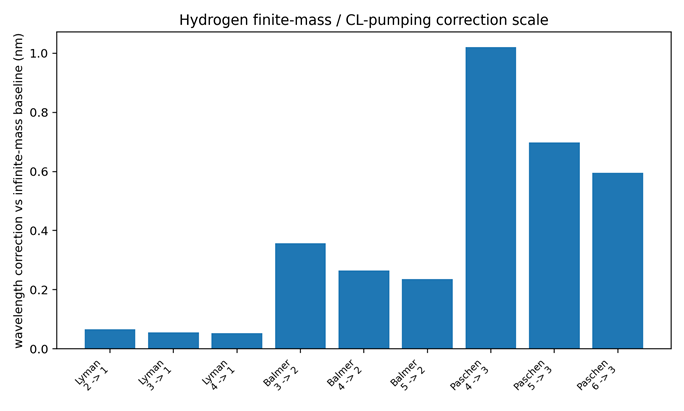
Figure 3. Representative hydrogen wavelength correction relative to the infinite-mass Rydberg baseline.
9. Comparison table: Lyman, Balmer, and Paschen lines
Table 1 lists representative reconstructed vacuum wavelengths. The third column uses the infinite-mass Rydberg constant. The fourth column applies the hydrogen finite-mass / CL-pumping correction.
Important note: the table gives Rydberg-level vacuum centroids. It is not a replacement for fine-structure, hyperfine, Lamb-shift, or full QED treatment. Its purpose is to connect the spectral scale to a finite-boundary interpretation.
|
Series |
Transition |
R_inf nm |
H-corrected nm |
Correction nm |
ppm |
|
Lyman |
2 -> 1 |
121.502273 |
121.568446 |
0.066172 |
544.617 |
|
Lyman |
3 -> 1 |
102.517543 |
102.573376 |
0.055833 |
544.617 |
|
Lyman |
∞ -> 1 |
91.126705 |
91.176334 |
0.049629 |
544.617 |
|
Balmer |
3 -> 2 |
656.112276 |
656.469606 |
0.357330 |
544.617 |
|
Balmer |
4 -> 2 |
486.009094 |
486.273782 |
0.264689 |
544.617 |
|
Balmer |
5 -> 2 |
433.936691 |
434.173020 |
0.236329 |
544.617 |
|
Balmer |
6 -> 2 |
410.070173 |
410.293504 |
0.223331 |
544.617 |
|
Balmer |
∞ -> 2 |
364.506820 |
364.705337 |
0.198517 |
544.617 |
|
Paschen |
4 -> 3 |
1874.606504 |
1875.627447 |
1.020943 |
544.617 |
|
Paschen |
5 -> 3 |
1281.469290 |
1282.167200 |
0.697910 |
544.617 |
|
Paschen |
6 -> 3 |
1093.520461 |
1094.116011 |
0.595550 |
544.617 |
|
Paschen |
∞ -> 3 |
820.140346 |
820.587008 |
0.446662 |
544.617 |
The complete table is provided as a CSV file in the supplementary package.
10. Extension beyond hydrogen
Prof. Sargoytchev correctly noted that this work should reflect not only on hydrogen but also on all neutral atoms and even molecules. The finite-boundary interpretation is therefore not limited to hydrogen. Hydrogen is the simplest case because it has one proton and one electronic resonance mode.
nuclear field structure + electron resonance capacity + CL/QFG coherence boundary -> finite neutral atom
atomic coherence boundaries + bonding resonance modes -> integrated molecular boundary
This makes hydrogen the first test case of a broader BSM-SG/QFG program: finite physical boundaries for neutral atoms and molecules.
11. Falsifiable high-n predictions
The strongest possible tests occur in very high-n Rydberg states, where the standard orbital radius picture becomes most extreme.
4. high-n states should show boundary-sensitive deviations in linewidths, lifetimes, or environmental response when the resonance mode approaches the finite coherence boundary.
5. high-n Rydberg states should show stronger dependence on cavity geometry, external electric-field gradients, plasma background, or local vacuum boundary conditions than an unbounded-orbit picture would suggest.
6. isotope dependence should not be limited to reduced mass only. Deuterium, as a two-node QFG structure, may show slightly different boundary-deformation signatures in high-n spectroscopy.
7. if no systematic high-n boundary, geometry, or environment-dependent residuals are observed beyond standard QED/reduced-mass corrections, the finite-boundary extension weakens.
12. Discussion and limitations
This essay makes a conservative claim. It does not claim that standard quantum mechanics is numerically wrong. It does not claim that the Rydberg formula fails. Instead, it proposes that BSM-SG/QFG supplies a finite physical interpretation beneath the successful spectral formalism.
The present numerical correction is equivalent to the known reduced-mass correction. The BSM-SG/QFG contribution is the physical interpretation of this corrected spectral scale as a finite-nucleus / CL-pumping efficiency and as a finite field-geometric resonance boundary.
The independent power of the theory will become stronger only if BSM-SG/QFG predicts measurable high-n corrections, line broadening, cavity dependence, isotope-specific residuals, or molecular boundary effects beyond the standard reduced-mass and QED corrections.
13. Conclusion
The problem addressed in this essay is not the numerical correctness of the hydrogen spectrum. The problem is the physical interpretation of the excited hydrogen atom when the Bohr radius is formally extended to high n.
BSM-SG/QFG proposes that the excited hydrogen atom has a finite physical boundary. Its spectral lines are transitions between resonance modes inside a proton-electron-CL/QFG field configuration, not evidence for unlimited material electron orbits.
The proposed title therefore states the central claim directly: Solution to the finite physical boundary problem of the excited hydrogen atom in the BSM-SG/QFG resonance framework.
The next decisive step is comparison with precision high-n Rydberg spectroscopy, isotope-resolved data, cavity-modified hydrogen spectra, and molecular spectroscopy.
Appendix A. Formal Bohr-radius growth
|
n |
Bohr radius (m) |
km |
Earth radii |
|
1 |
5.29177e-11 |
5.29177e-14 |
8.30603e-18 |
|
2 |
2.11671e-10 |
2.11671e-13 |
3.32241e-17 |
|
3 |
4.76259e-10 |
4.76259e-13 |
7.47543e-17 |
|
10 |
5.29177e-09 |
5.29177e-12 |
8.30603e-16 |
|
100 |
5.29177e-07 |
5.29177e-10 |
8.30603e-14 |
|
1000 |
5.29177e-05 |
5.29177e-08 |
8.30603e-12 |
|
10000 |
0.00529177 |
5.29177e-06 |
8.30603e-10 |
|
1e+06 |
52.9177 |
0.0529177 |
8.30603e-06 |
|
3.46979e+08 |
6.371e+06 |
6371 |
1 |
Acknowledgements
The author expresses sincere gratitude to Prof. Stoyan Sargoytchev for developing the Basic Structures of Matter - Supergravitation framework and for his guidance on the interpretation of the Bohr surface, CL-space, and the finite physical boundary problem of the excited hydrogen atom. The author also acknowledges the planned review input of Ivan Kostadinov before final submission.
Author Biography
Viktor Stefanov Pronchev is an independent researcher from Bulgaria with professional experience in IT security and computational systems. His research interests include quantum-field geometry, computational modeling of atomic structures, and the extension of the BSM-SG framework toward testable resonance-based interpretations of matter. He develops QFG-based computational methods for visualizing and analyzing finite-boundary atomic and molecular systems.
References
8. Sargoytchev, S. S. Basic Structures of Matter - Supergravitation Unified Theory, second book edition, 2025.
9. Sargoytchev, S. S. BSM-SG Chapter 7: Hydrogen atom; sections on Bohr surface, quasishrunk CL space, Balmer series, and photon emission.
10. Sargoytchev, S. S. BSM-SG Chapter 3: Electron; section on first harmonic motion and the Rydberg constant.
11. Pronchev, V. and Sargoytchev, S. BSM-SG/QFG background notes on hydrogen, Bohr surface, and finite coherence boundary. BSM-SG Computing, 2026. https://www.bsm-sg-computing.com/revisiting-the-hydrogen-spectrum-through-the-lens-of-bsm-sg/
12. QFG-Atlas, uploaded manuscript, 2026. Sections on hydrogen as a proton-centered resonance field and finite psi-field coherence boundary.
13. QFG 2, uploaded manuscript, 2026. Minimal QFG spinor/gauge/topological formalization and measurement/instrumentation layer.
14. NIST Reference on Constants, Units, and Uncertainty: CODATA value of the Rydberg constant.
15. NIST Atomic Spectra Database and Atomic Data for Hydrogen: critically evaluated wavelengths and energy levels.
16. Bohr, N. On the constitution of atoms and molecules. Philosophical Magazine, 1913.
17. Balmer, J. J. Notiz uber die Spectrallinien des Wasserstoffs. Annalen der Physik, 1885.